Next Gen Drug Discovery: A Computer-Aided Perspective Crash Course
Master precision computational pipelines to design and optimize next-generation therapeutic molecules. Bridge the gap between structural biology and AI-driven pharmaceutical discovery in this comprehensive 6-month internship.
Course Description
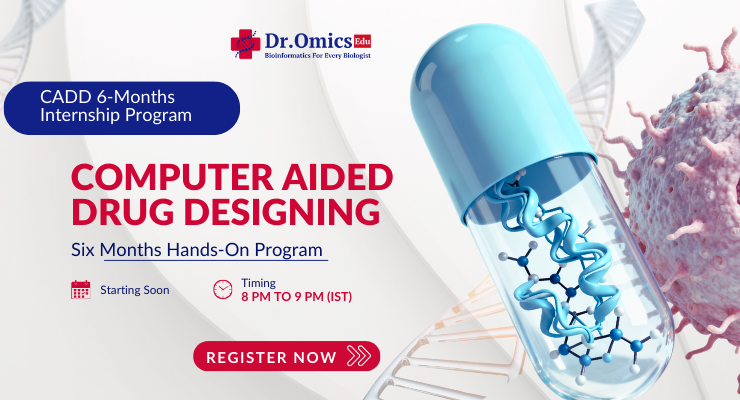
Transform your understanding of modern pharmaceutical discovery with the intensive layout detailed in CADD_6month_L11scwy.jpg. This "Computer Aided Drug Designing: Six Months Hands-On Program" is an extensive internship engineered by Dr. Omics Edu to cultivate advanced computational pharmacology expertise. Participants will dive deep into both structure-based and ligand-based drug design paradigms, learning to navigate macromolecular targets and complex chemical spaces. The extensive curriculum guides you through critical industry practices, including molecular docking simulations, virtual screening, and pharmacophore mapping. By incorporating state-of-the-art AI prediction models, deep learning algorithms, and quantitative structure-activity relationship (QSAR) workflows, learners will predict drug toxicity and binding affinities with high precision. This 6-month program transitions traditional biochemistry knowledge into highly reproducible biocomputing pipelines. Ultimately, this structural informatics training prepares life science professionals to innovate within biotechnology companies, clinical research organizations, and academic drug-discovery labs.
What You'll Learn
Core fundamentals of computer-aided drug design (CADD) and molecular modeling architectures.
High-throughput virtual screening methodologies to identify promising lead compounds from vast chemical libraries.
Advanced molecular docking protocols to evaluate binding affinity and target-ligand interactions.
How to use AI-driven prediction tools to assess ADMET (Absorption, Distribution, Metabolism, Excretion, and Toxicity) profiles.
Strategies for ligand optimization, pharmacophore modeling, and computational hit-to-lead refinement.
Practical deployment of industry-standard molecular dynamics and simulation software packages.
Curriculum
-
Month 1: Introduction to CADD, Chemical Databases (PubChem, Zinc), and Target Structure Retrieval from the PDB.
Lesson -
Month 2: Ligand Preparation, Molecular File Conversions, and Advanced Geometry Optimization Workflows.
Lesson -
Month 3: Active Site Identification, Grid Generation, and High-Throughput Molecular Docking Simulations.
Lesson -
Month 4: Pharmacophore Mapping, 2D/3D QSAR Modeling, and Ligand-Based Virtual Screening Strategies.
Lesson -
Month 5: AI-Driven ADMET Profiling, Toxicity Prediction Models, and Cheminformatics Pipeline Automation.
Lesson -
Month 6: Molecular Dynamics (MD) Simulations, Trajectory Analysis, and Capstone Research Project Presentation.
Lesson
