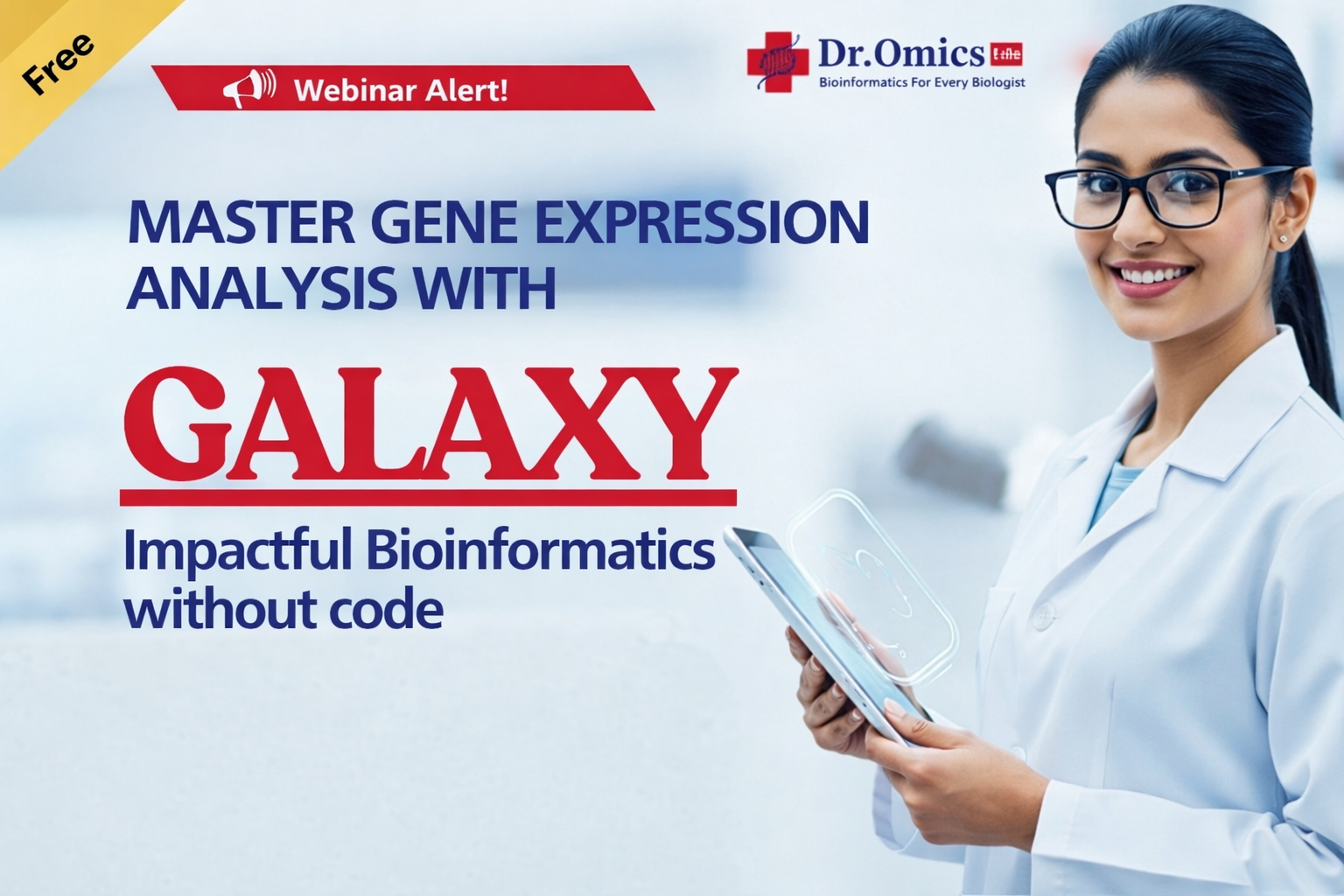
Master Gene Expression Analysis with Galaxy: Impactful Bioinformatics without Code
Unlock powerful transcriptomic insights and master complex differential gene expression analysis workflows entirely code-free. Leverage the web-based Galaxy platform and AI-driven data modeling to transition seamlessly from raw sequence data to publication-ready results.
Course Description
In the data-driven landscape of modern life sciences, parsing transcriptomic sequencing results often poses a daunting coding barrier for researchers. This career-oriented webinar presented by Dr. Omics Labs breaks down these technological hurdles by introducing the intuitive, web-based Galaxy platform. Designed specifically for biologists, clinicians, and students, the course demonstrates how to execute end-to-end gene expression workflows without writing a single line of code. Participants will navigate essential cloud-based data pipelines, moving efficiently from raw transcriptomic read processing to robust differential expression interpretation. By integrating automated analytics with machine learning principles, this training solves the classical computational bottlenecks that delay genomic discoveries. Attendees will gain a thorough understanding of how to manage quality metrics, map sequences, and visualize complex multi-omics patterns. Ultimately, this course provides a clear blueprint to accelerate your laboratory's genomic workflows, enhancing your competitive standing in the biotechnology industry.
What You'll Learn
The architecture of web-based, code-free bioinformatics pipelines using the Galaxy ecosystem.
How to import, assess, and execute automated quality control filtering on raw high-throughput sequencing data.
Practical deployment of alignment and quantification tools to evaluate transcript abundance.
Statistical and machine learning applications for clustering and visualizing differential expression patterns.
Best practices for sharing, reproducing, and scaling genomic workflows to meet global scientific standards.
Curriculum
-
Introduction to the Galaxy interface, open-source bioinformatics databases, and no-code tool navigation.
Lesson -
High-throughput transcriptomic raw data preprocessing, read trimming, and quality control optimization.
Lesson -
Running code-free read mapping and alignment pipelines against reference transcriptomes.
Lesson -
Quantifying expression levels, managing normalized data metrics, and identifying significant gene changes.
Lesson -
Advanced AI-supported downstream visualization, cluster heatmaps, and functional pathway interpretation.
Lesson
