CRISPR/Cas9 Gene Editing Journey – 5-Day Hands-On Workshop
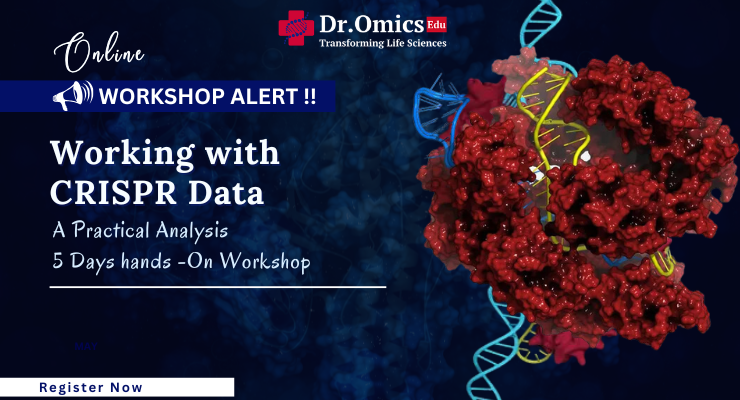
Master real-world genomic editing datasets through five days of intensive, hands-on data interpretation pipelines. Learn to optimize guide RNA targets and evaluate post-editing sequence variations using automated bioinformatics tools.
Course Description
This intensive 5-day online training program provides a robust, hands-on deep-dive into working with CRISPR data. Participants will explore complex computational biology pipelines, learning how to manipulate and evaluate digital datasets generated by modern genome editing experiments. The curriculum details specific workflows for target locus prediction, automated guide RNA (gRNA) design, and machine-learning-based off-target scoring algorithms. By processing multi-omic sequence files, you will discover how to track DNA repair pathways and quantify insertion-deletion (indel) frequencies precisely. This practical analysis workshop bridges the gap between molecular wet-lab engineering and data-driven computational discovery. Whether your research objective is evaluating high-throughput screen outputs or identifying structural variants, you will gain essential data analytics skills. Elevate your quantitative scientific capability, resolve common sequencing alignment bottlenecks, and unlock predictive frameworks for modern biotechnology research.
What You'll Learn
The systematic data structures and formats generated during high-throughput CRISPR genome editing experiments.
How to use computational algorithms and genomic browsers to extract target sequence files.
Proven methodologies to design highly specific gRNAs and accurately predict genomic cleavage efficiency.
Strategies to deploy predictive bioinformatic software to map, analyze, and minimize off-target mutations.
Practical approaches for evaluating post-editing deep sequencing datasets to determine repair outcomes.
Curriculum
-
Module 1: Molecular mechanics of CRISPR adaptive immunity, PAM site mapping, and structural biology of Cas9 variants.
Lesson -
Module 2: AI-assisted computational sgRNA design, off-target forecasting algorithms, and mismatch modeling.
Lesson -
Module 3: Wet-lab preparation of genomic reagents, plasmid engineering, and cellular delivery/transfection execution.
Lesson -
Module 4: Post-editing cell culture monitoring, tissue harvesting, and genomic DNA extraction procedures.
Lesson -
Module 5: Running PCR-based validation assays, quantifying indel frequencies, and exporting final data summaries.
Lesson
