Whole Genome Sequencing (WGS) vs Whole Exome Sequencing (WES): Which Is Right for Your Study?
July 3, 2026
Choosing the right sequencing strategy is one of the most important decisions in any genomics project. Whether you're studying rare diseases, cancer, or population genetics, understanding the differences between Whole Genome Sequencing (WGS) and Whole Exome Sequencing (WES) can help you maximize results while staying within budget.
This WGS vs WES comparison provides a simple guide to selecting the best approach for your research in 2026.
What Is Whole Exome Sequencing (WES)?
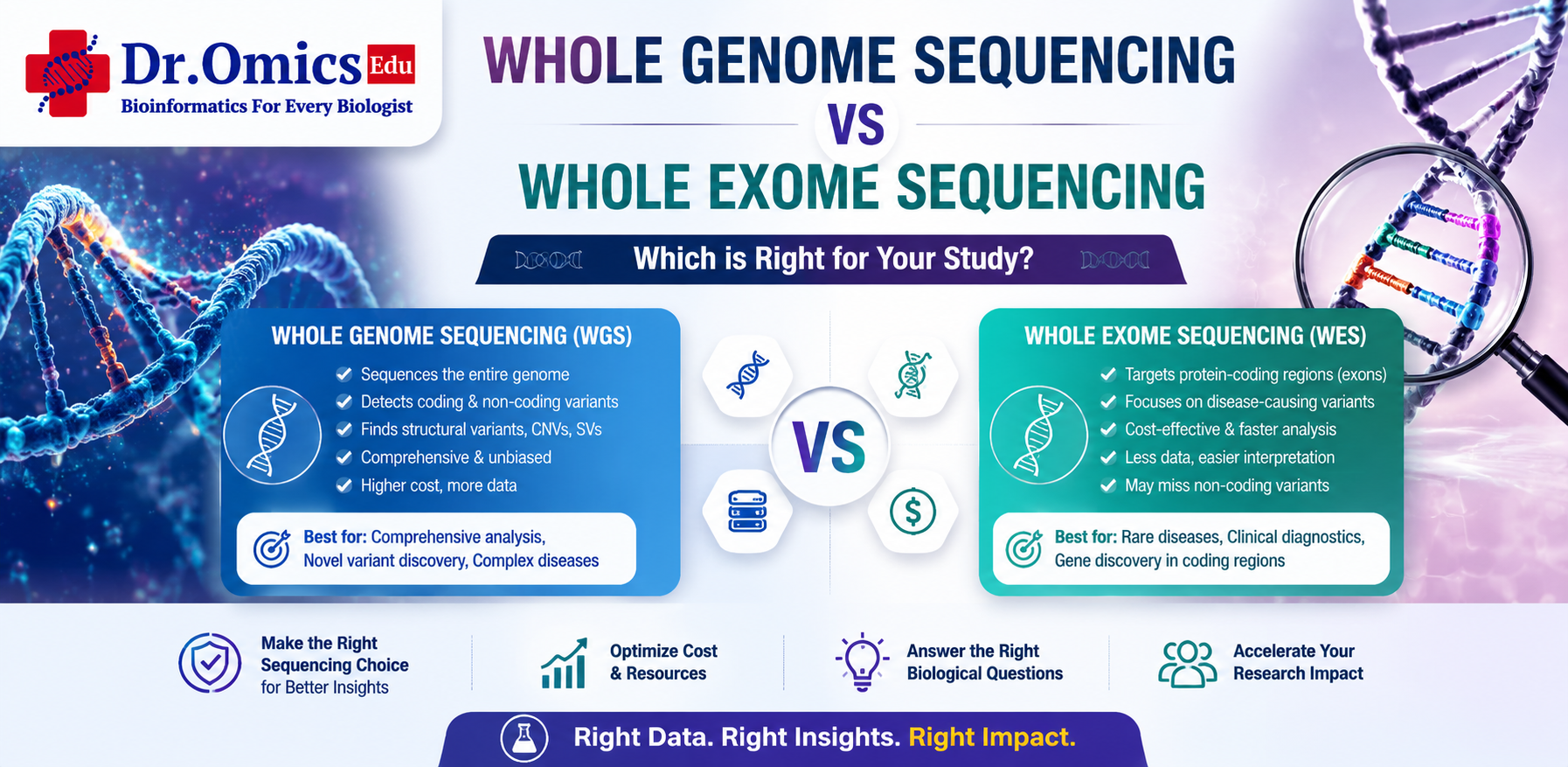
Whole Exome Sequencing (WES) targets only the protein-coding regions (exons) of the genome, representing 1–2% of the human genome. Since most known disease-causing variants occur in exons, WES is widely used for clinical diagnostics and rare disease research.
Best suited for:
- Rare disease diagnosis
- Mendelian disorders
- Clinical genomics
- Gene discovery in coding regions
Advantages
- Lower sequencing cost
- Faster data analysis
- High coverage of coding regions
- Ideal for exome sequencing rare disease studies
What Is Whole Genome Sequencing (WGS)?
Whole Genome Sequencing (WGS) sequences the entire genome, including coding and non-coding regions. It provides the most comprehensive view of genetic variation and is increasingly used in advanced research and precision medicine.
Best suited for:
- Structural variant detection
- Non-coding variant analysis
- Complex genetic disorders
- Population genomics
- Comprehensive genome-wide studies
Advantages
- Complete genome coverage
- Detects SNPs, indels, structural variants, and copy number variants
- No exome capture bias
- Better for discovering novel variants
WGS vs WES: Quick Comparison
Feature | ||
Genome Coverage | Protein-coding regions only | Entire genome |
Target Region | ~1–2% of genome | 100% of genome |
Cost | Lower | Higher |
Data Generated | Moderate | Very large |
Variant Detection | Mainly coding variants | Coding + non-coding + structural variants |
Best For | Rare disease diagnosis | Comprehensive genomic analysis |
WGS vs WES Cost Comparison (2026)
For many projects, cost remains a major factor.
- WES is generally the preferred option when focusing on known disease-associated coding regions and offers a lower cost per sample.
- WGS requires a higher investment but delivers complete genome information, making it valuable for studies involving structural variants, regulatory regions, or novel variant discovery.
As sequencing technologies continue to evolve, the WGS cost per sample in 2026 is decreasing, making whole-genome studies more accessible than ever.
WGS, WES, or Targeted Panel: Which Should You Choose?
Study Goal | Recommended Approach |
Known disease-associated genes | Targeted gene panel |
Rare disease diagnosis | Whole Exome Sequencing (WES) |
Novel variant discovery | Whole Genome Sequencing (WGS) |
Structural variant analysis | Whole Genome Sequencing (WGS) |
Clinical diagnostic testing | WES or targeted panel (depending on indication) |
How to Choose the Right Sequencing Method
Your NGS study design should be guided by:
- Research objective – Are you studying known genes or exploring the entire genome?
- Budget – WES remains more economical for many clinical studies.
- Variant types of interest – WGS captures both coding and non-coding variants, including structural changes.
- Data analysis capacity – WGS generates significantly larger datasets and requires greater computational resources.
Final Thoughts
There is no single "best" sequencing method—only the one that best fits your study.
- Choose WES when your focus is on coding-region variants, especially for rare disease studies and cost-effective clinical research.
- Choose WGS when you need complete genome coverage, comprehensive variant detection, or are investigating complex genetic mechanisms.
A well-planned sequencing method selection improves data quality, reduces unnecessary costs, and ensures your research addresses the right biological questions from the start.
