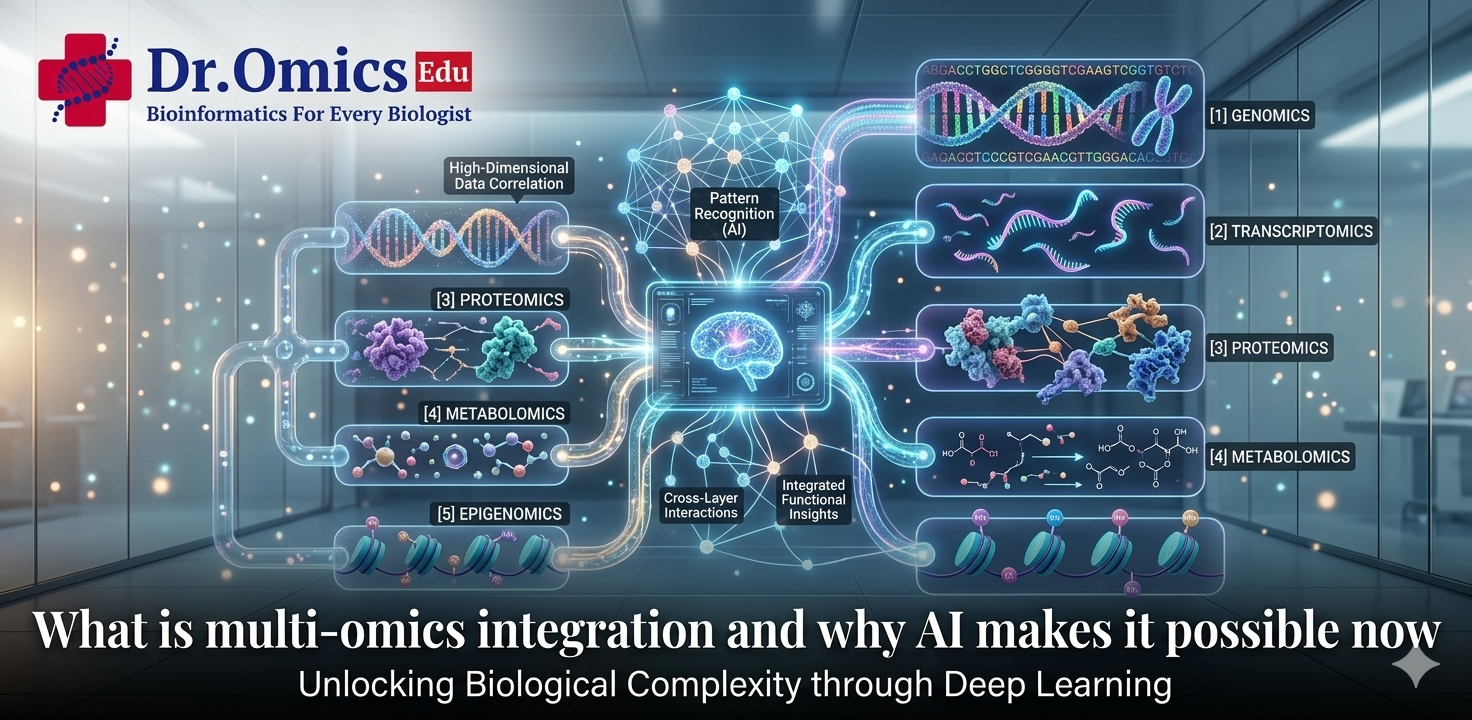
What is Multi-Omics Integration and Why AI Makes It Possible Now
June 24, 2026
For decades, biological research operated in silos. We analyzed the body one isolated layer at a time—sequencing DNA, measuring RNA, or cataloging proteins. But biology does not happen in a single dimension; the static blueprint is not the final building.
Enter multi-omics integration 2026: the most transformative frontier in omics systems biology. By blending disparate molecular data layers, scientists are finally gaining a holistic view of human health. However, dealing with this massive, multi-dimensional data deluge was historically an impossible computational nightmare. Here is how Artificial Intelligence is breaking down the walls and making true integration possible today.
What is Multi-Omics Integration and How Does It Work?
To understand what is multi-omics integration and how does it work, imagine trying to map a complex city. Looking only at DNA (genomics) is like viewing a static satellite photograph—it shows the structure and what might happen. To know what is actually happening, you need to layer real-time traffic updates (the transcriptome) and the physical activity inside the buildings (the proteome).
A modern multi-omics bioinformatics workflow achieves exactly this. By executing a synchronized genomics transcriptomics proteomics integration, researchers map how a genetic mutation alters downstream RNA expression, shifts protein abundance, and ultimately drives clinical disease. This complete approach transforms pan-omics bioinformatics from a collection of isolated data snapshots into a continuous, high-definition molecular movie.
The Analytical Bottleneck: Why Traditional Math Failed
Until recently, running integrative omics analysis tools felt like translating five languages simultaneously without a dictionary. Traditional computational approaches consistently failed due to two massive roadblocks:
- The Dimension Curse: High-throughput sequencers generate millions of molecular features, but these are often measured across relatively small patient cohorts, leading to severe statistical overfitting.
- Massive Heterogeneity: DNA data is static and structural; RNA data is highly variable; proteomics and metabolomics data are dynamic, noisy, and continuously changing.
Standard statistical frameworks simply collapse when forcing multi-omics data fusion across these vastly different biological timelines and incompatible, unstructured file formats.
How AI Enables Multi-Omics Data Integration in Research
So, what changed? The explosion of specialized, deep learning AI multi-omics analysis frameworks. AI does not just crunch numbers faster; it fundamentally changes how AI enables multi-omics data integration in research.
Advanced machine learning architectures—such as Graph Neural Networks (GNNs), Transformers, and Deep Variational Autoencoders—excel at identifying complex, non-linear biological patterns. Modern omics data AI tools ingest massive, fragmented matrices from multi-omics analysis tools for genomics and proteomics, weed out background technical noise, and automatically correct for platform-specific batch effects.
By compressing these giant datasets into a lower-dimensional embedding space, systems biology AI 2026 engines can seamlessly harmonize disparate layers. They reveal hidden cellular interactions and cross-talk networks that escape human observation, making the data highly interactive and searchable.
The Ultimate Payoff: Precision Medicine
The final destination for this technological revolution is precision medicine multi-omics. Rather than treating complex diseases like cancer, diabetes, or neurodegeneration based on broad population averages, clinicians can leverage AI to discover multi-layered, highly specific biomarkers.
These integrated profiles allow medical teams to predict drug resistance before a clinical trial even begins, match patients with hyper-targeted therapies, and discover entirely novel therapeutic checkpoints. Driven by AI, multi-omics has successfully evolved from a chaotic data dump into an actionable, predictive roadmap for personalized healthcare.
