Top Companies Hiring Bioinformaticians (Salaries & Skills Required)
June 26, 2026
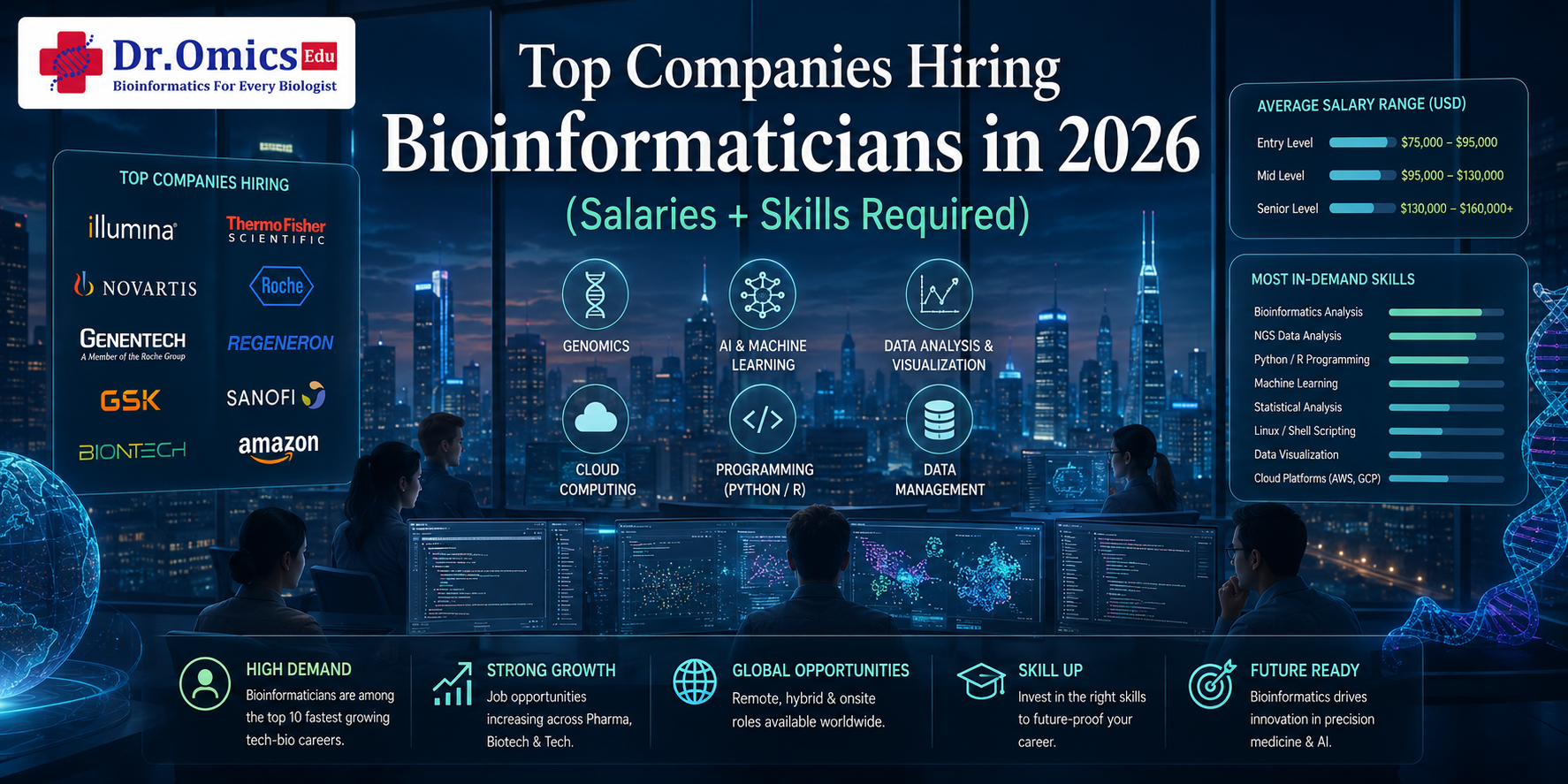
The intersection of data science and molecular biology has solidified bioinformatics jobs as some of the most lucrative and critical roles in modern science. Driven by breakthroughs in generative AI, personalized medicine, and mRNA technologies, global biotech hiring in genomics has hit an all-time high. If you are looking to enter the field, understanding which companies hire bioinformaticians—and what they pay—is your roadmap to navigating the job market.
The Big Titans: Who is Hiring?
The employment landscape for computational biologists is anchoring around three primary pillars: industry giants, sequencing innovators, and world-class research institutes.
1. The Therapeutics & Pharma Leaders: Genentech & Moderna
These powerhouses dominate pharma genomics jobs. At Genentech, computational biologists work deeply within oncology and immunology, translating massive clinical trial datasets into targeted therapies. Meanwhile, Moderna continues to scale its mRNA platform, hiring bioinformaticians to optimize digital vaccine designs and predict structural RNA interactions.
2. The Infrastructure King: Illumina
As the pioneer of sequencing hardware, Illumina is a massive recruiter for NGS jobs in life sciences. Bioinformaticians here focus heavily on the software side—developing primary analysis algorithms, variant-calling software, and cloud systems to process the torrent of data generated by high-throughput sequencers.
3. The Research Powerhouses: Broad Institute & NIH
For those drawn to large-scale, open-science ecosystems, Broad Institute and NIH bioinformatics jobs offer premier destinations. These organizations recruit heavily to manage population-scale genomic initiatives (like the All of Us Research Program) and build open-source tools utilized by the global scientific community.
Critical Bioinformatics Job Requirements
Landing a seat at these prestigious institutions requires a highly specific dual-competency in software engineering and biological systems.
To stand out, you must cultivate these core pharma genomics jobs skills:
- Programming Mastery: Professional-grade fluency in Python or R is mandatory. You must be able to write clean, reproducible, and well-documented code.
- Pipeline Architecture: Deep practical knowledge of Next-Generation Sequencing (NGS) workflows—such as RNA-Seq, single-cell genomics, and spatial transcriptomics—using workflow managers like Nextflow or Snakemake.
- Infrastructure & Environment: Strong proficiency in Linux/Bash environments and cloud computing platforms (AWS, Google Cloud, or Azure) to manage petabyte-scale data safely.
- Advanced AI/ML: A foundational grasp of machine learning framework libraries (like PyTorch or Scikit-learn) for predictive biological modeling.
Skills required to get a bioinformatics job at Moderna or Genentech: Beyond general pipeline building, these specific companies heavily favor candidates with proven expertise in structural bioinformatics (e.g., AlphaFold variations) and multi-omics data integration.
Bioinformatics Pay Scale: India vs. USA Comparison
The global computational biology salary framework reflects a highly competitive market, though it varies significantly by geographic region.
Region / Metric | Entry-Level / Analyst | Senior / Principal Scientist | Key Industry Hubs |
| United States | $85,000 – $110,000 | $150,000 – $220,000+ | Boston/Cambridge, San Francisco Bay Area, San Diego |
| India | ₹4.5 – ₹8 Lakhs Per Annum (LPA) | ₹18 – ₹32+ Lakhs Per Annum (LPA) | Bengaluru, Hyderabad, Pune, Delhi-NCR |
For early-career scientists trying to break into the industry, internships are the ultimate stepping stone. The bioinformatics internship salary in India currently averages around ₹25,000 to ₹45,000 per month at major contract research organizations (CROs), multinational pharma hubs, and elite institutes like the IISc.
Final Takeaway
The data is clear: academic credentials alone no longer guarantee entry. The industry overwhelmingly values candidates who can prove their technical utility through open-source contributions, robust GitHub portfolios, and a cross-disciplinary ability to speak both the language of code and the language of clinical biology.
