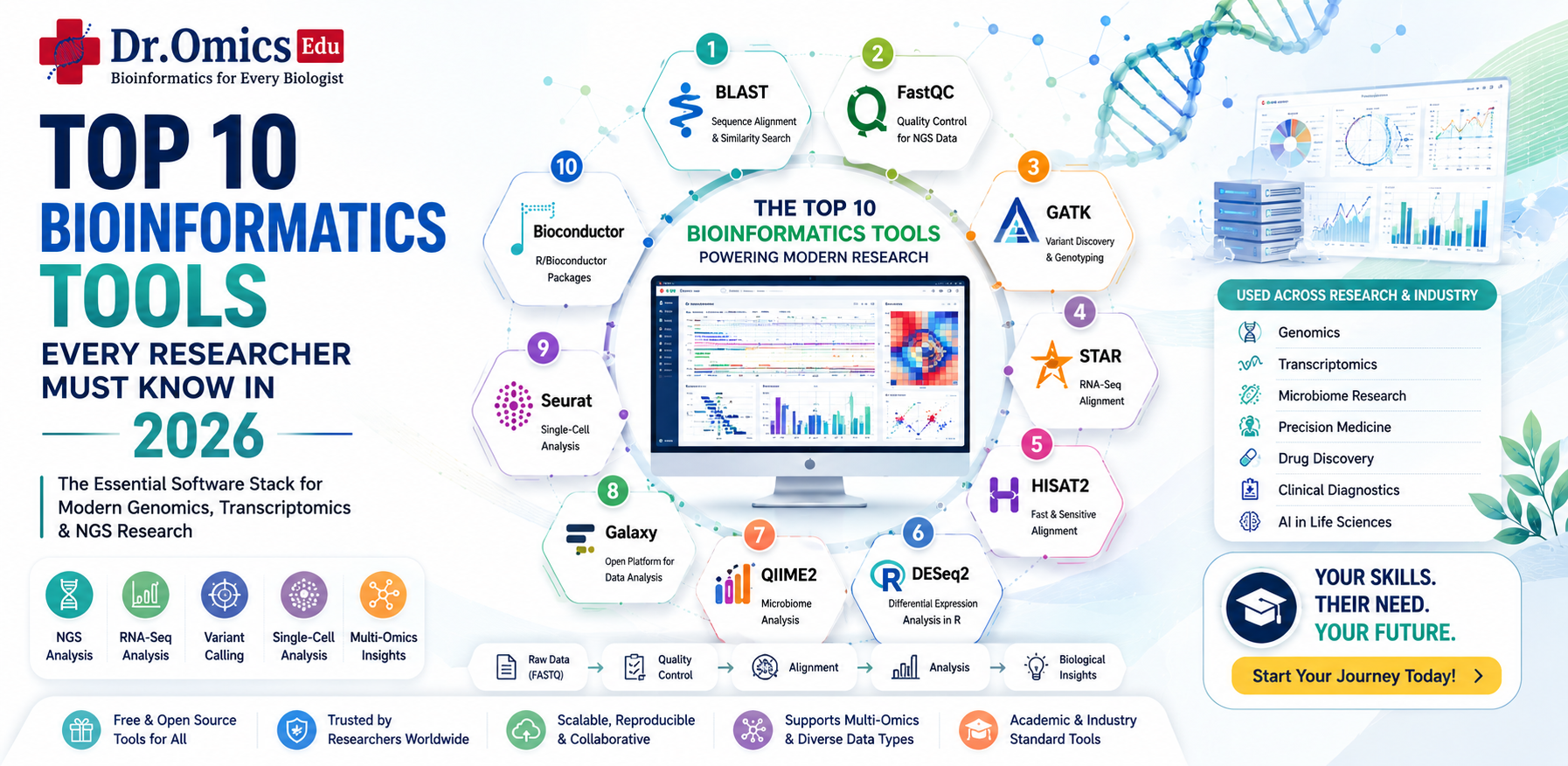
Top 10 Bioinformatics Tools Every Researcher Must Know in 2026
June 20, 2026
The life sciences are experiencing an unprecedented data deluge. High-throughput sequencing technologies churn out petabytes of raw genomic data daily, turning biological research into a thoroughly data-driven science. For biotechnology students, molecular researchers, and job seekers aiming to enter the pharmaceutical sector, navigating this massive digital landscape is no longer optional—it is a critical requirement.
If you are wondering which bioinformatics tools should I learn first in 2026 to maximize your research impact and employability, this definitive NGS software list for 2026 outlines the absolute essentials.
The Core Data Flow: From Raw Reads to Biological Insights
Modern computational biology requires workflows that are stable, scalable, and completely reproducible. These essential free bioinformatics tools for students and researchers form the backbone of next-generation sequencing analytics, scaling easily from single-gene lookups to massive multi-omics pipelines.
Raw FASTQ Reads ──> FastQC (QC) ──> STAR/HISAT2 (Alignment) ──> GATK (Variant Discovery)
The Top 10 Essential Platforms
1. BLAST (Basic Local Alignment Search Tool)
The absolute baseline for sequence similarity searches. BLAST rapidly compares unknown nucleotide or protein sequences against global public repositories to infer functional and evolutionary relationships.
2. FastQC
A critical initial data check. A standard FastQC quality control tutorial teaches researchers how to evaluate raw sequence files, flag adapter contamination, and eliminate low-quality reads before mapping.
3. STAR & 4. HISAT2
When processing RNA-Seq datasets, aligning reads across spliced junctions is a major computational challenge. The STAR HISAT2 alignment tool options handle this seamlessly: STAR offers ultra-fast mapping for complex eukaryotic transcriptomes, while HISAT2 provides an incredibly memory-efficient alternative using minimal RAM.
5. GATK (Genome Analysis Toolkit)
Developed by the Broad Institute, GATK is the industry standard for variant discovery. Every foundational BLAST GATK QIIME2 tutorial highlights its Best Practices pipeline for identifying single nucleotide polymorphisms (SNPs) and indels in clinical and population genomics workflows.
6. DESeq2
The premier package within the DESeq2 bioinformatics R environment. It utilizes a negative binomial distribution model to precisely isolate significant fold-changes in gene expression across differing experimental conditions.
7. Seurat & 8. Bioconductor
Single-cell RNA sequencing (scRNA-Seq) has revolutionized cellular biology. Seurat is the indispensable R package for exploring this high-resolution data, integrating natively into the broader Seurat GATK Bioconductor tools ecosystem, which houses thousands of specialized packages for structural and functional genomic analysis.
9. QIIME2
A discovery powerhouse for microbiome studies. It processes raw amplicon or metagenomic sequences to generate reproducible insights into microbial community structures and environmental dynamics.
10. Galaxy Platform
For researchers who want to run the top NGS analysis tools without diving deep into the Linux command line, the web-based Galaxy bioinformatics platform 2026 offers a clean, drag-and-drop graphical user interface to construct pipelines effortlessly.
Tool Quick Comparison
| Tool | Core Function | Best For | Key Limitation |
| BLAST | Sequence Alignment | Database similarity matching | Slow with massive modern datasets |
| FastQC | Quality Control | Raw sequence integrity checks | Does not modify or trim data |
| STAR | Spliced Alignment | High-speed RNA-Seq mapping | High RAM consumption |
| GATK | Variant Discovery | Highly accurate variant calling | Complex setup, steep learning curve |
| DESeq2 | Differential Expression | Quantifying gene changes | Requires raw count matrices |
| QIIME2 | Microbiome Analysis | Deciphering microbial ecology | Heavy reliance on reference databases |
Industry Applications & Career Perspective
These top 10 bioinformatics tools for NGS data analysis drive innovation across precision medicine, targeted drug discovery, and clinical diagnostics. Because of this, the biotechnology job market has an immense demand for professionals who can comfortably navigate bioinformatics pipeline tools.
Employers actively look for candidates who can automate these individual tools using workflow managers (like Nextflow) and scale analyses across remote cloud environments. As bioinformatics tools 2026 trends lean heavily toward AI integration and machine learning, mastering this core best bioinformatics software ensures your scientific skill set remains completely future-proof.
