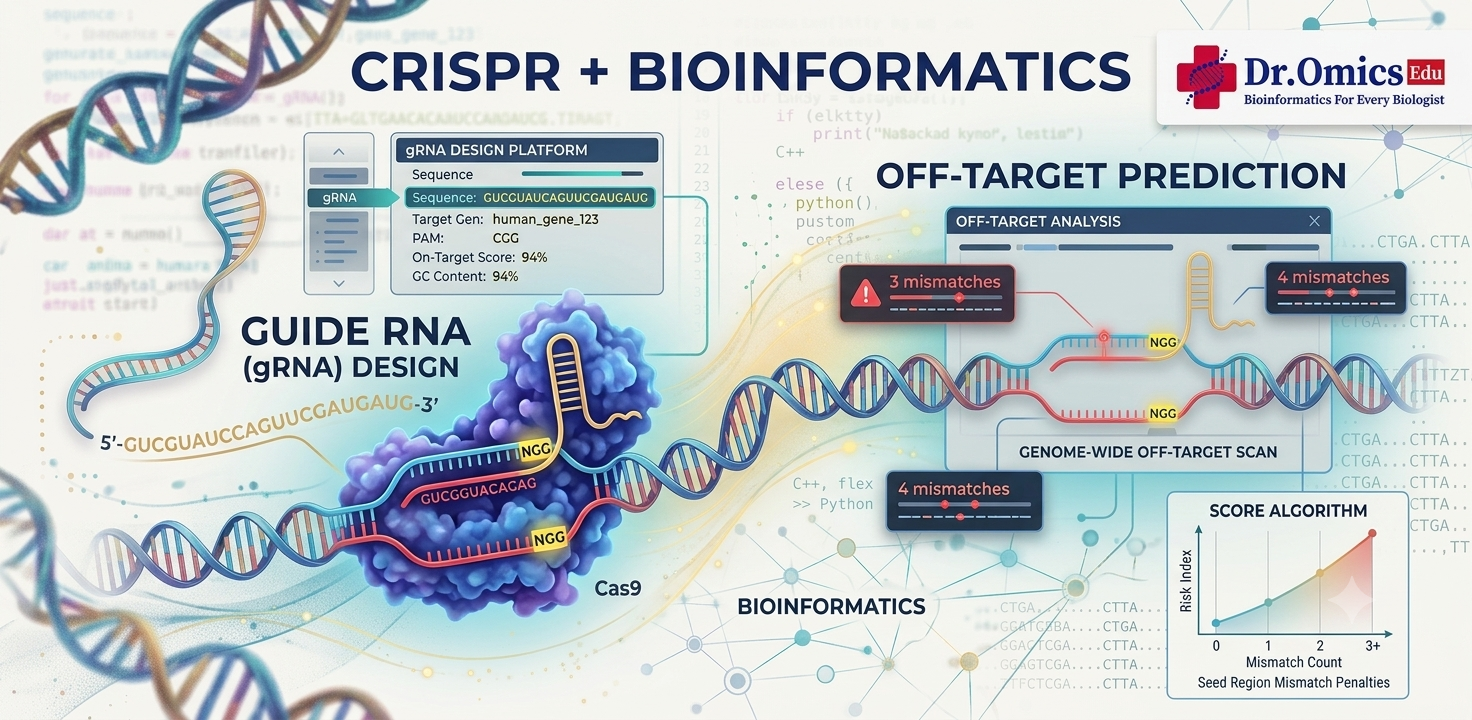
The CRISPR Bioinformatics Frontier: Designing Guides & Predicting Off-Targets
July 2, 2026
The evolution of genomic medicine relies entirely on precision editing. While the biochemical machinery of CRISPR-Cas9 genome editing analysis handles the physical cutting of DNA, computational biology coordinates the entire experiment. Navigating CRISPR bioinformatics 2026 platforms requires a clear understanding of how guide RNA (gRNA) selection, off-target modeling, and advanced editing platforms operate.
1. Streamlining Guide RNA Design
If you are running a CRISPR off-target prediction tutorial for beginners, the first step is learning how to design guide RNA for CRISPR using bioinformatics tools. Modern web interfaces like the CRISPOR Benchling guide RNA tools let you input a gene identifier or custom FASTA sequence. The software automatically scans the DNA sequence for Protospacer Adjacent Motifs (PAM)—such as the 5'-NGG sequence required by classic SpCas9—and extracts the flanking 20-nucleotide sequence to build your spacer candidates.
Predicting gRNA Efficiency
Not all guides bind or cut with equal potency. Advanced gRNA efficiency prediction models assess explicit structural rules to determine the best candidates. The algorithms prioritize a balanced GC content (typically 40%–60%), penalize poly-T tracts that trigger premature transcription termination, and evaluate structural thermodynamics to ensure your guide won't form self-complementary internal hairpin loops.
2. Resolving the Off-Target Bottleneck
The primary safety risk in clinical genome editing is unintended cutting at non-target genomic sites. To mitigate this risk, CRISPR off-target prediction relies on intensive sequence-alignment passes against the host reference genome.
Advanced Off-Target Scoring Algorithms
Bioinformatics tools use specialized math models to weight mismatched base pairs between your guide and the genome:
- Position-Dependent Penalties: Mismatches located near the PAM site (the critical 8–10 bp "seed region") significantly disrupt Cas9 binding. Mismatches here dramatically lower the predicted off-target risk score compared to mismatches at the far distal end of the guide.
- Algorithmic Modeling: Traditional pipelines rely on empirical scoring systems (like the MIT or CFD scores). In 2026, cutting-edge software integrates deep learning architectures (such as CRISPR-net) to capture complex, non-linear DNA-RNA structural interactions.
3. Screens, Base Editing, and Prime Editing
As genome engineering advances past basic double-stranded breaks, the technical stack adapts accordingly:
- CRISPR Screen Analysis: For high-throughput loss-of-function studies, CRISPR functional genomics tools deploy specific pipelines like MAGeCK or BAGEL2. These tools handle raw fastq read counts from pooled libraries to identify which gRNAs are systematically enriched or depleted across populations.
- Base Editing & Prime Editing Bioinformatics: Precision modifications that bypass double-stranded breaks require specialized algorithmic adjustments. Platforms for base editing prime editing bioinformatics analyze narrow, localized editing windows (e.g., positions 4–8 relative to the PAM) to convert single nucleotides or map optimal prime editing guide RNAs (pegRNAs), which require precise primer binding sites and reverse transcriptase templates.
Essential Bioinformatics Tools for CRISPR Experiment Design 2026
- CRISPOR / Benchling: Excellent web applications for quick genomic sequence visualization, on/off-target scoring, and automated primer design.
- Cas-OFFinder: A fast, GPU-accelerated alignment engine that searches for genome-wide off-target configurations with multiple mismatches and bulges.
- CRISPResso2: The industry-standard pipeline used to analyze downstream NGS amplicon sequencing data to quantify actual insertion, deletion (indel), or base-substitution efficiencies.
