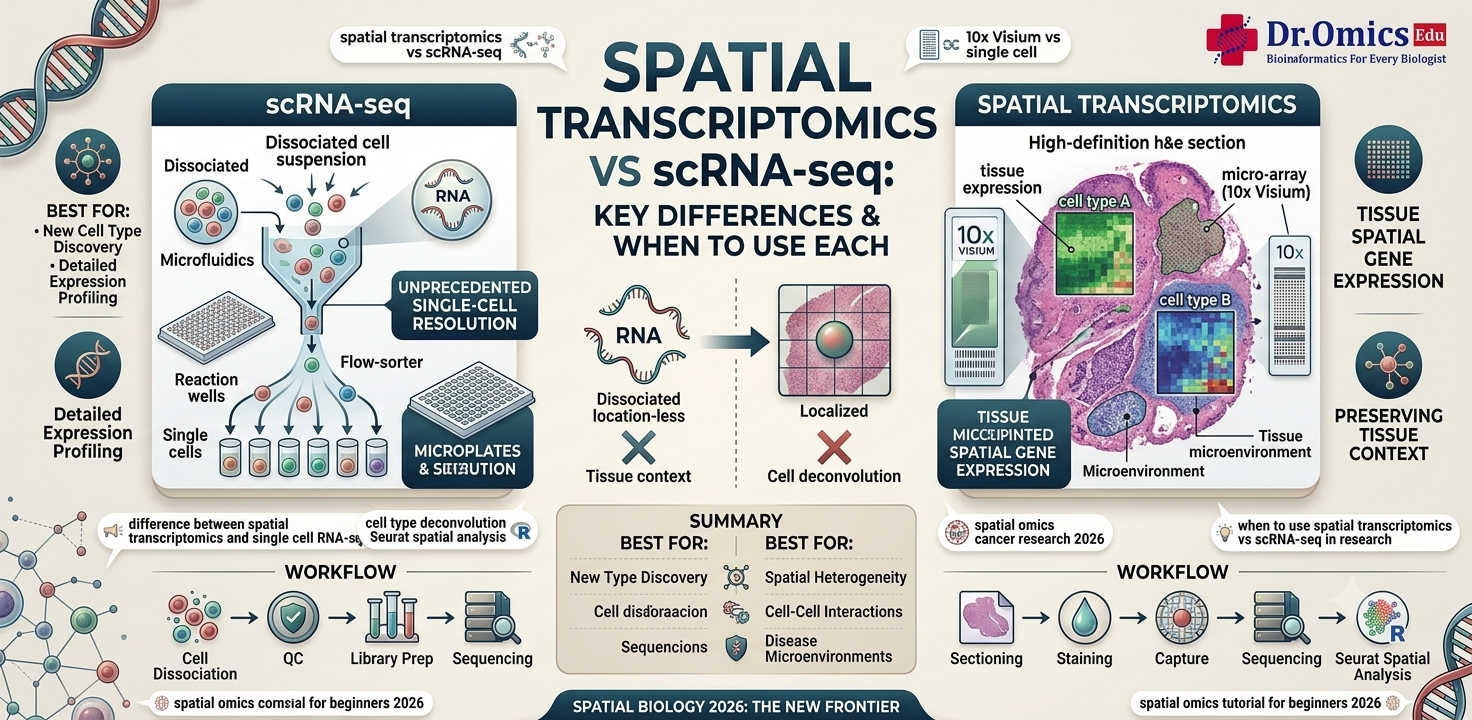
Spatial Transcriptomics vs scRNA-seq: Key Differences and When to Use Each
June 29, 2026
As spatial biology 2026 continues to transform biomedical research, scientists increasingly face an important question: Spatial transcriptomics vs scRNA-seq—which technology is best for my study?
Both methods provide powerful insights into gene expression, but they answer different biological questions. Understanding the difference between spatial transcriptomics and single-cell RNA-seq is essential for selecting the right approach.
What is scRNA-seq?
Single-cell RNA sequencing (scRNA-seq) measures gene expression at the individual cell level, enabling researchers to identify cell types, discover rare populations, and study cellular heterogeneity.
Advantages
- Single-cell resolution
- Excellent for cell type identification
- Detects rare cell populations
- Large ecosystem of analysis tools
Limitation
During tissue dissociation, spatial information is lost, making it difficult to understand where cells are located within the tissue.
What is Spatial Transcriptomics?
Tissue spatial gene expression technologies preserve the physical location of cells while measuring gene activity across tissue sections. This allows researchers to map molecular patterns directly onto tissue architecture.
Popular platforms include 10x Visium vs single cell approaches, which combine transcriptomics with tissue imaging.
Advantages
- Preserves tissue context
- Reveals cell-cell interactions
- Supports tissue mapping transcriptomics
- Ideal for studying tissue organization and disease microenvironments
Limitation
Most spatial technologies provide lower resolution and may capture multiple cells per spot.
Spatial Transcriptomics vs scRNA-seq: Quick Comparison
Feature | ||
Resolution | Single-cell | Tissue-based spatial spots |
Spatial Information | No | Yes |
Cell Type Discovery | Excellent | Moderate |
Tissue Architecture Analysis | Limited | Excellent |
Cost | Lower | Higher |
Cancer Microenvironment Studies | Good | Excellent |
When to Use Spatial Transcriptomics vs scRNA-seq in Research
Choose scRNA-seq when:
- Discovering new cell populations
- Characterizing cellular heterogeneity
- Building cell atlases
- Studying developmental processes
Choose Spatial Transcriptomics when:
- Investigating tissue organization
- Understanding tumor microenvironments
- Exploring cell-cell communication
- Performing spatial omics cancer research
Best Practice: Combine Both
Many modern spatial omics comparison 2026 studies integrate scRNA-seq with spatial data. Researchers often use scRNA-seq to identify cell types and then apply cell type deconvolution spatial methods to map those cells back into tissues.
Common Spatial Gene Expression Tools
Researchers frequently use:
- 10x Visium
- Seurat spatial analysis R
- Squidpy
- Giotto
- STUtility
These tools support advanced spatial transcriptomics workflow tutorial pipelines and help analyze complex tissue datasets.
Final Thoughts
The debate of spatial transcriptomics vs scRNA-seq is not about choosing a winner—it is about selecting the right tool for the biological question. If you need detailed cellular profiling, scRNA-seq remains the gold standard. If tissue context matters, spatial transcriptomics provides unparalleled insights into tissue architecture and cellular interactions.
As spatial omics tutorial for beginners 2026 resources continue to grow, combining both technologies is becoming the preferred strategy for next-generation biomedical research.
