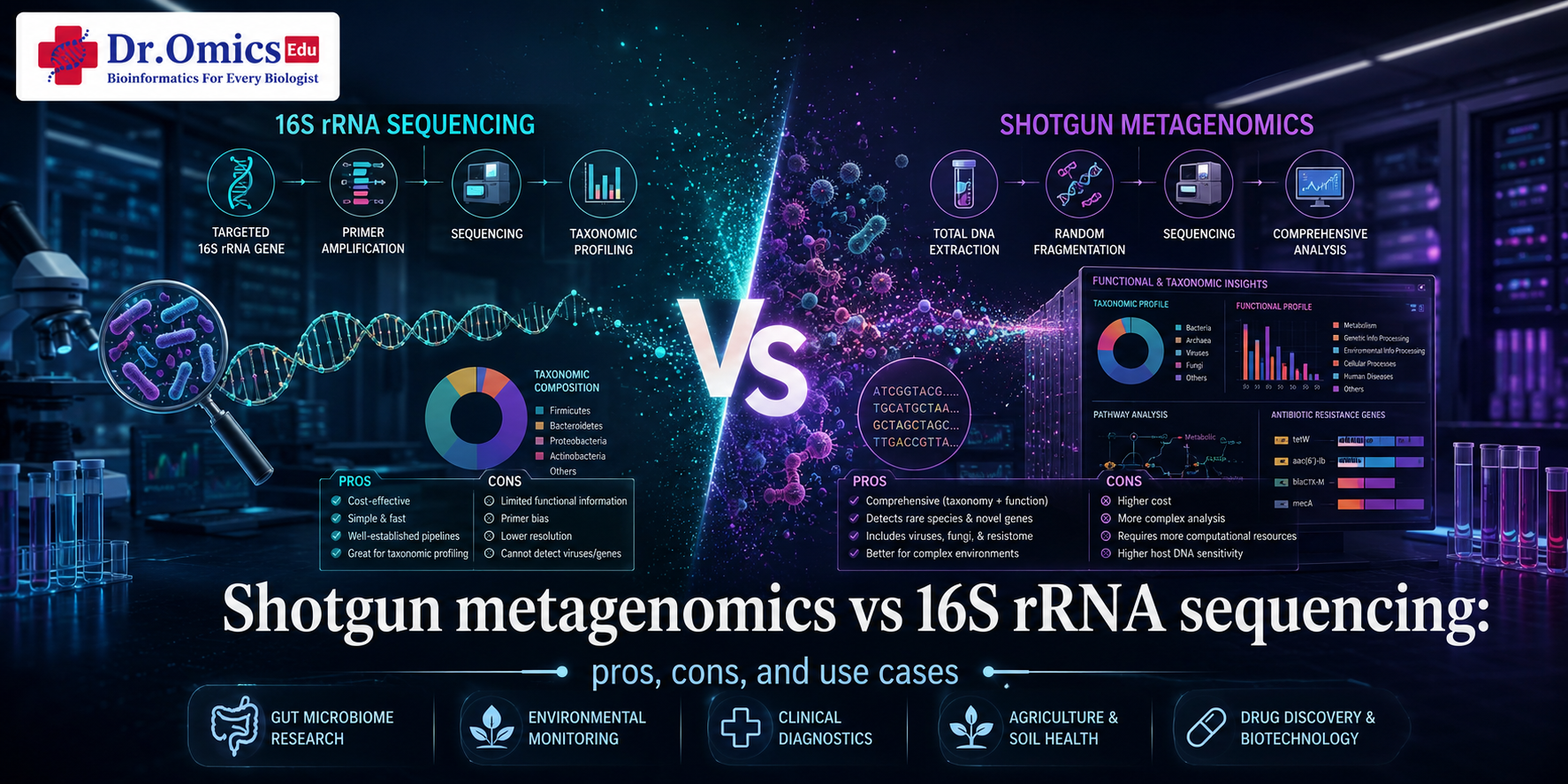
Shotgun Metagenomics vs. 16S rRNA Sequencing: The Microbiome Comparison Guide
June 30, 2026
When designing a microbiome study, choosing between amplicon vs shotgun sequencing dictates your entire experimental and computational approach. Both methods serve as staples in microbiome research, but they answer fundamentally different questions: Who is there? versus What can they do? Here is an explicit metagenomics methods comparison evaluating shotgun metagenomics vs 16S rRNA sequencing to help you choose the right approach for your project.
1. 16S rRNA Amplicon Sequencing: Targeted Profiling
16S rRNA sequencing targets and amplifies specific hypervariable regions (e.g., V4 or V3-V4) of a single, highly conserved marker gene present in all bacteria and archaea.
- Pros: Highly cost-effective; works exceptionally well on low-biomass or heavily host-contaminated samples (e.g., tissue or skin tumors) because primers selectively isolate microbial DNA.
- Cons: Suffer from PCR amplification bias; limited taxonomic resolution (usually restricted to the genus level); cannot capture viruses, fungi, or metabolic functions.
- Primary Use Cases: Large-scale population cohorts, high-throughput exploratory screening, and low-budget clinical trials prioritizing broad community shifts.
2. Shotgun Metagenomics: Unbiased Global Resolution
Whole metagenome sequencing (WMS), specifically WMS whole metagenome shotgun, sequences all genomic DNA present in a sample without target amplification.
- Pros: Achieves deep, strain-level taxonomic resolution; simultaneously sequences bacteria, viruses, fungi, and phages; enables a comprehensive microbiome function analysis.
- Cons: Significantly higher 16S amplicon vs shotgun sequencing cost and depth comparison barriers; highly vulnerable to host DNA contamination; requires vast data storage and heavy computational power.
- Primary Use Cases: Outbreak tracking, novel pathogen identification, biomarker discovery, and deep metabolic characterization.
3. High-Throughput Processing Workflows
The analytical pipeline you build depends entirely on the technology selected:
Raw Sequencing Reads
16S Amplicon Analysis
- Primer Trimming
- DADA2 / QIIME2
- ASV Taxonomic Assignment
Shotgun Metagenomics Analysis
- Host DNA Removal (Bowtie2)
- Taxonomic Profiling (MetaPhlAn, Kraken2, Sylph)
- Functional Analysis (HUMAnN)
Output
- Microbial Composition
- Functional Pathways
- Biological Insights & Interpretation
In a typical environmental metagenomics workflow utilizing shotgun reads, raw fastq files undergo host filtering before deployment to leading taxonomic profiling tools 2026. Modern setups leverage tools like MetaPhlAn (a marker-based approach providing relative taxonomic abundance) and Kraken2 (a fast, k-mer-based alignment tool to measure sequence abundance). Following classification, tools like HUMAnN are used to map reads to metabolic pathways, unlocking structural functional metagenomics analysis.
Summary Matrix: Which Should I Use?
| Feature | 16S rRNA Amplicon | Shotgun Metagenomics (WMS) |
| Primary Metric | Relative abundance of target taxa | Total taxonomic & functional capacity |
| Taxonomic Limit | Genus (rarely species) | Species and distinct strains |
| Kingdoms Detected | Bacteria & Archaea only | Bacteria, Archaea, Viruses, Eukaryotes |
| Functional Insight | Predictive only (e.g., PICRUSt2) | Direct metabolic pathway profiling |
| Host Vulnerability | Very low (ignored by primers) | High (requires heavy filtering) |
The Verdict
When debating shotgun metagenomics vs 16S rRNA which should I use, let your biological objective guide you. If you are conducting broad exploratory profiling on a tight budget, stick to 16S amplicon loops. If you require absolute strain resolution or intend to uncover actionable metabolic pathways, the structural pros and cons of shotgun metagenomics for microbiome research tilt clearly toward investing in an end-to-end shotgun workflow.
