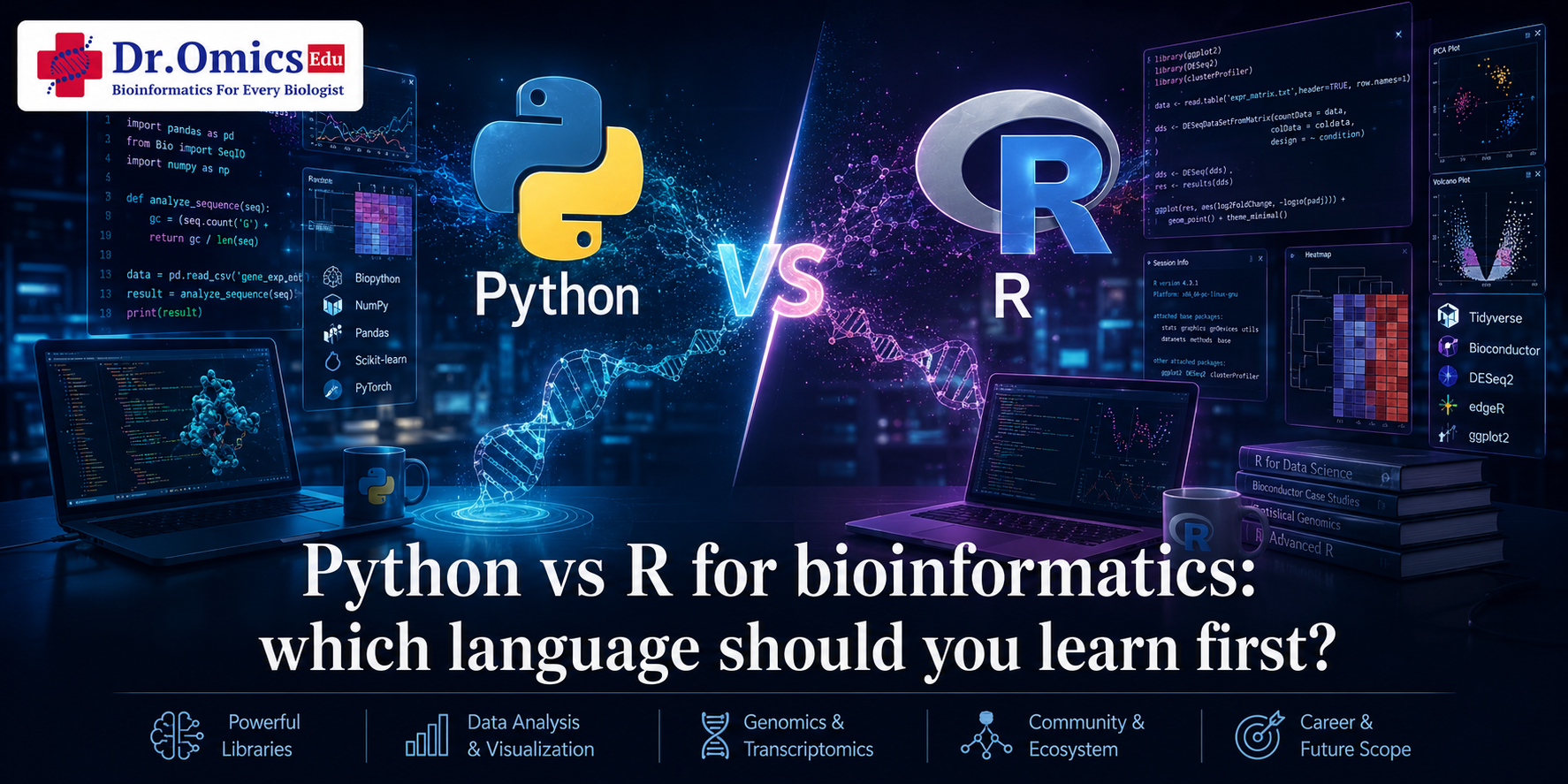
Python vs R for Bioinformatics: Which Language Should You Learn First?
June 22, 2026
If you are a beginner stepping into computational biology, you are likely facing the ultimate dilemma: Python or R?
Both dominate modern biology, but they serve entirely different masters. To understand which to learn first, let's look at the cornerstone of high-throughput genomics: the NGS variant analysis workflow. By tracing how a variant calling pipeline tutorial operates, the choice becomes crystal clear.
The Heavy Lifting: Python and the Command Line
When handling raw Next-Generation Sequencing (NGS) data, your primary goal is infrastructure, scale, and speed. A typical FASTQ to VCF workflow requires orchestrating massive text files through multiple compiled command-line tools.
Python acts as the ultimate glue language to automate this sequence. For instance, in a variant calling pipeline for beginners bioinformatics guide, a Python script or workflow manager (like Snakemake) handles the heavy processing data orchestration:
- BWA alignment tutorial steps: Mapping raw FASTQ reads to a reference genome.
- Samtools bcftools pipeline execution: Converting SAM files to compressed BAM files, sorting, and indexing them.
- GATK best practices 2026 protocols: Running the GATK4 tutorial 2026 workflow using tools like HaplotypeCaller for robust SNP indel detection NGS.
Whether you are focusing on germline somatic variant calling, Python provides the ecosystem needed to build a repeatable, production-grade FASTQ to annotated VCF file complete workflow.
The Interpretation: R for Statistical Analytics
Once your pipeline spits out a Variant Call Format (VCF) file, the engineering phase ends, and the statistical exploration begins. This is where R completely outshines Python.
R is built from the ground up for data visualization and matrix manipulation. After you perform downstream variant filtering annotation, you need to extract biological meaning. R excels at taking heavily structured data—like the outputs from variant annotation VEP ANNOVAR tools—and turning them into publication-ready plots.
If you want to filter variants by allele frequency, plot depth distribution, or perform complex gene-set enrichment analyses on annotated mutations, R’s Bioconductor ecosystem is unmatched.
The Verdict: How to Choose Your Step-by-Step Path
To master how to run a variant calling pipeline using GATK step by step, you actually need both. But you shouldn't learn them at the exact same time.
[Raw FASTQ Reads] ──( Python / Bash Automation )──> [VCF File] ──( R Analytics )──> [Biological Insights]
Choose Python First If:
You want to build pipelines, manage massive raw datasets, handle cloud computing, or dive into machine learning. Python is a foundational software engineering skill that makes learning tool execution effortless.
Choose R First If:
You are working with pre-processed data tables, performing differential gene expression (like RNA-seq), or need to create complex statistical models and beautiful figures for a paper immediately.
The Golden Rule: Start with Python to build your variant filtering annotation infrastructure, then adopt R to analyze the science behind the data.
