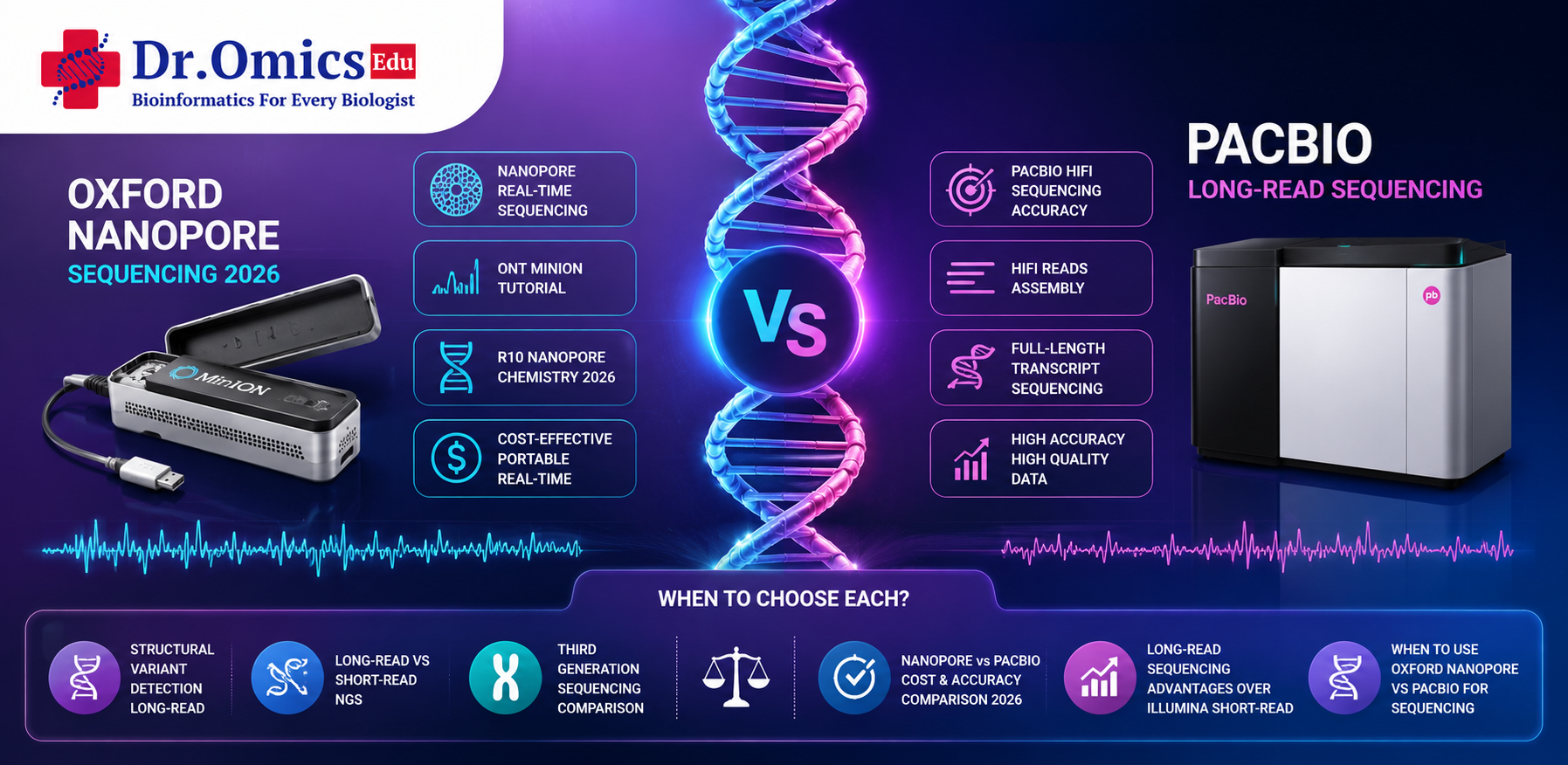
Long-Read Sequencing with Oxford Nanopore vs PacBio: Which Platform Should You Choose in 2026?
June 27, 2026
The era of long-read sequencing has transformed genomics by enabling researchers to resolve complex genomes, detect structural variants, and sequence full-length transcripts with unprecedented clarity. While Illumina short-read sequencing remains the standard for many applications, choosing between Oxford Nanopore sequencing and PacBio long-read sequencing depends on your research goals, budget, and accuracy requirements.
Let's explore when to use Oxford Nanopore vs PacBio for sequencing in 2026.
Why Choose Long-Read Sequencing?
Unlike short-read NGS, which typically generates reads of 150–300 bp, long-read technologies produce reads ranging from several kilobases to even megabases. This makes them ideal for:
- Structural variant detection
- De novo genome assembly
- Full-length transcript sequencing
- Repetitive and GC-rich regions
- Haplotype phasing
- Complex genomic rearrangements
These are the key long-read sequencing advantages over Illumina short-read platforms.
Oxford Nanopore Sequencing (ONT)
Oxford Nanopore sequencing 2026 continues to lead in portability and real-time sequencing. Devices like MinION, GridION, and PromethION enable sequencing anywhere—from research labs to field locations.
Best for:
- Rapid pathogen surveillance
- Clinical outbreak investigations
- Ultra-long DNA sequencing
- Environmental and metagenomic studies
- Real-time sequencing workflows
Recent improvements, including R10 nanopore chemistry (2026), have significantly enhanced raw read accuracy while maintaining ultra-long read capabilities.
Key Advantages
- Real-time data generation
- Portable devices (ideal for fieldwork)
- Ultra-long reads (>100 kb possible)
- Lower initial instrument cost
- Flexible throughput
PacBio HiFi Sequencing
PacBio long-read sequencing is renowned for producing highly accurate HiFi reads, making it the preferred choice for applications where precision is critical.
Best for:
- High-quality genome assembly
- Variant discovery
- Clinical genomics
- Full-length transcript sequencing
- Population genomics
With PacBio HiFi sequencing accuracy often exceeding 99.9%, researchers can confidently identify SNPs, indels, and structural variants.
Key Advantages
- Exceptional read accuracy
- Excellent for de novo assembly
- Superior variant calling
- Reliable full-length isoform sequencing
Oxford Nanopore vs PacBio: Quick Comparison
Feature | Oxford Nanopore | PacBio HiFi |
Read Length | Ultra-long | Long |
Accuracy | High (improving with R10 chemistry) | Very high (>99.9% HiFi) |
Real-time Sequencing | Yes | No |
Portability | Excellent | Laboratory-based |
Genome Assembly | Excellent | Outstanding |
| Structural Variant Detection | Excellent | Excellent |
Cost | Lower entry cost | Higher instrument investment |
When Should You Choose Each?
Choose Oxford Nanopore if you need:
- Real-time sequencing
- Field-based or portable sequencing
- Ultra-long reads
- Rapid turnaround
- Budget-friendly instrument options
Choose PacBio if you need:
- Maximum sequencing accuracy
- High-quality genome assemblies
- Clinical-grade variant analysis
- Accurate full-length transcript sequencing
Final Thoughts
The debate isn't about which platform is better—it's about which platform is best for your project.
- Oxford Nanopore excels in portability, flexibility, and nanopore real-time sequencing.
- PacBio HiFi remains the gold standard for highly accurate long-read sequencing and genome assembly.
As third-generation sequencing technologies continue to evolve in 2026, both platforms are driving breakthroughs in genomics, precision medicine, and transcriptomics. Understanding the strengths of each will help you make the right choice for your sequencing workflow.
Whether you're performing structural variant detection, assembling complex genomes, or exploring full-length RNA isoforms, long-read sequencing has become an essential tool in modern bioinformatics.
