How to Build a Bioinformatics Portfolio That Gets You Hired
June 28, 2026
The computational biology job market has shifted. While academic credentials lay the groundwork, biotech companies and clinical labs now demand proof of execution. If you want to stand out, you need a structured, public-facing showcase of your skills.
Here is your definitive bioinformatics portfolio guide to transitioning from an aspiring analyst to a hired scientist.
1. Curate a High-Impact Computational Biology Job Portfolio
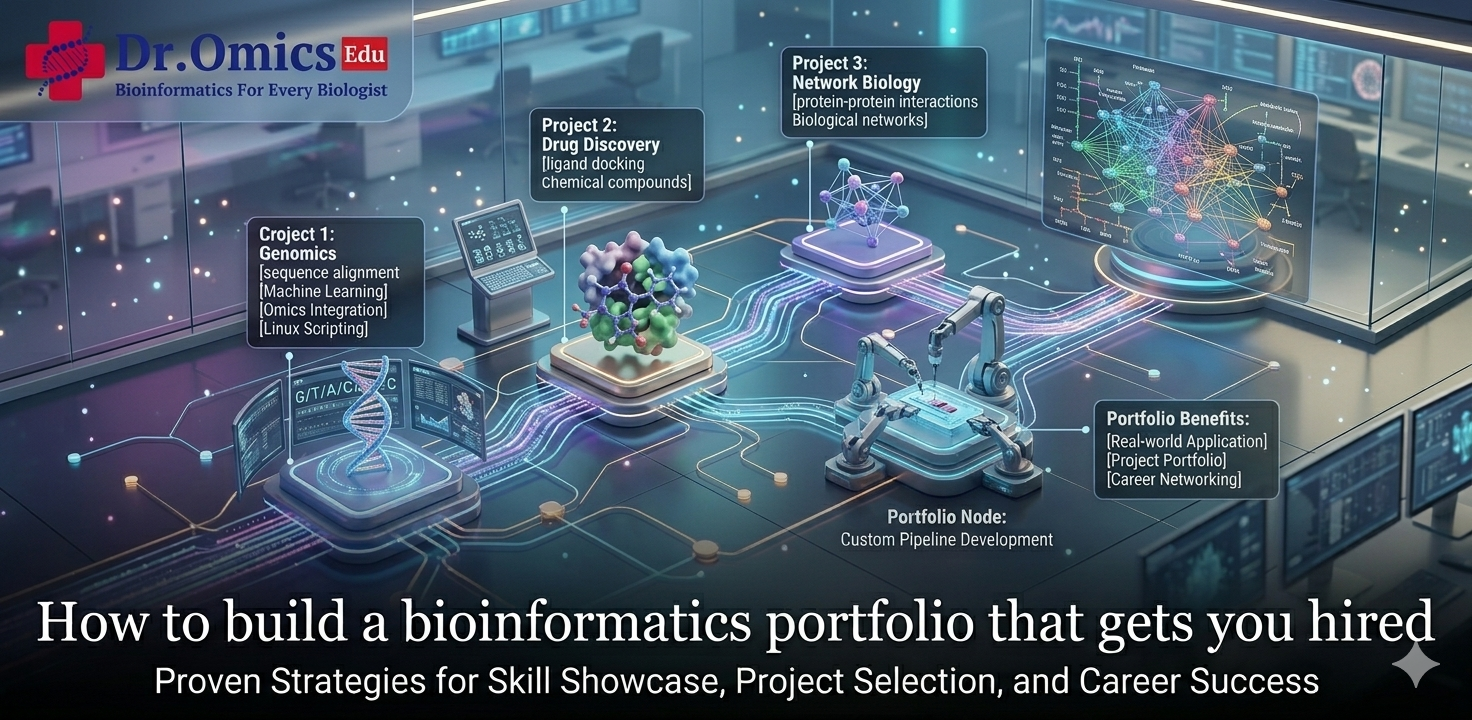
A stellar computational biology job portfolio isn’t a dumping ground for half-finished scripts; it is a curated narrative of your problem-solving abilities. For an effective portfolio for genomics career roles, aim for 3 to 4 deeply realized projects hosted on GitHub, linked directly from a clean personal landing page.
If you are designing a bioinformatics portfolio for students, avoid basic classroom assignments. Instead, look for bioinformatics project ideas 2026 that tackle real-world analytical bottlenecks, such as a scalable, automated NGS pipeline GitHub project (e.g., variant calling or RNA-seq analysis) or a single-cell RNA-seq clustering workflow.
2. Demonstrate Industry Readiness with No Experience
If you are wondering how to build a bioinformatics portfolio with no experience, the secret lies in proving you can write production-grade code.
Hiring managers want to see a fully documented bioinformatics workflow. Move beyond local execution by incorporating:
- Workflow Managers: Build pipelines using Nextflow or Snakemake to prove you understand reproducibility.
- Containerization: Include a Dockerfile or Conda environment.yml file so employers can replicate your work instantly.
- Literate Programming: Utilize a Jupyter notebook bioinformatics workflow for exploratory analysis, using markdown blocks to explain why you chose specific filtering parameters.
3. Master the Documentation & Git Workflow
The best bioinformatics GitHub projects to showcase for jobs are defined by their documentation. Knowing how to document a bioinformatics pipeline for your portfolio is critical. Every project in your GitHub bioinformatics projects tab must feature a comprehensive README.md containing:
The Portfolio Pipeline Blueprint:
- Biological Objective: What disease or organism are you analyzing?
- Architecture Diagram: A visual flowchart mapping the tools used (e.g., FastQC → STAR → FeatureCounts).
- Copy-Pasteable Commands: Clear installation and execution steps.
- Biological Insights: A 3-sentence conclusion explaining what the final plots mean biologically.
To further elevate your profile, make an open source bioinformatics contribution. Submitting a pull request to fix a bug or enhance documentation in community tools like Bioconda or nf-core proves you can collaborate within an established codebase.
4. Align with Your Resume
Your portfolio and resume must act as a unified unit. Implement these quick bioinformatics resume tips to maximize impact:
- Hyperlink directly: Place your GitHub URL at the top of your resume and hyperlink individual project titles directly to their repositories.
- Focus on results: Instead of writing "Ran differential expression," write "Developed an RNA-seq pipeline identifying 14 novel biomarkers, reducing target screening time by 20%."
By focusing on reproducibility, biology-driven insights, and flawless documentation, your portfolio will confidently speak for your expertise.
