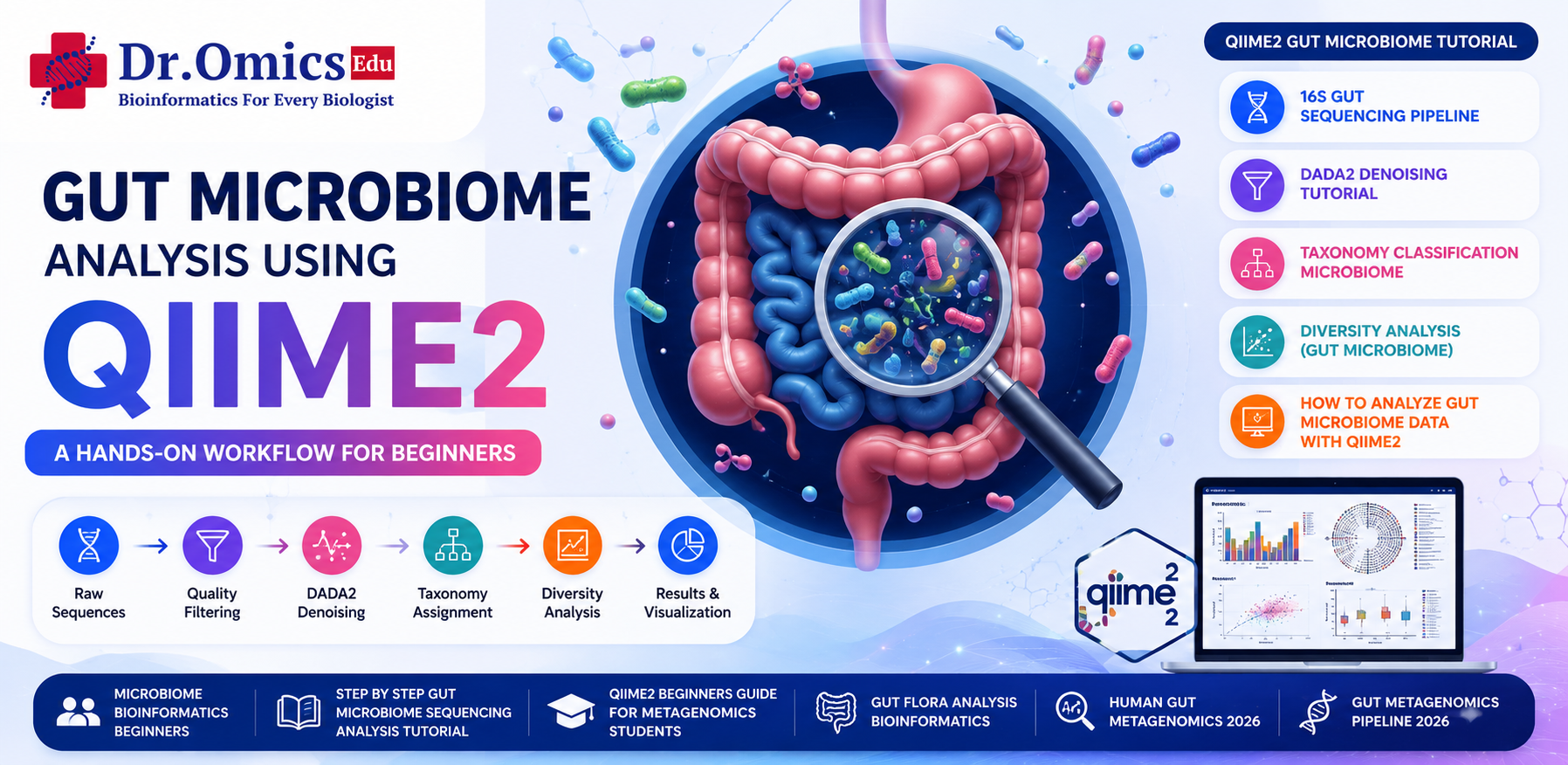
Gut Microbiome Analysis Using QIIME2: A Hands-On Workflow for Beginners
June 23, 2026
The human gut contains trillions of microorganisms that influence digestion, immunity, metabolism, and overall health. With advances in sequencing technologies, researchers can now study these microbial communities in detail using QIIME2, one of the most popular microbiome bioinformatics platforms.
If you're new to microbiome research, this beginner-friendly guide will walk you through a typical gut microbiome analysis workflow using QIIME2.
What is QIIME2?
QIIME2 (Quantitative Insights Into Microbial Ecology 2) is an open-source bioinformatics platform used for analyzing microbial communities from sequencing data. It provides tools for quality control, taxonomic classification, diversity analysis, and visualization.
Today, QIIME2 is widely used in human gut metagenomics and microbiome research projects worldwide.
Typical Gut Microbiome Analysis Workflow
1. Generate 16S rRNA Sequencing Data
Most gut microbiome studies begin with 16S gut sequencing, where specific regions of the bacterial 16S rRNA gene are sequenced to identify microbial species present in a sample.
2. Import Data into QIIME2
Raw FASTQ files are imported into QIIME2 and summarized to assess sequencing quality before downstream analysis.
3. Quality Control and Denoising with DADA2
One of the most important steps in the 16S gut sequencing pipeline is removing sequencing errors and low-quality reads.
Using DADA2 denoising, QIIME2 can:
- Filter poor-quality sequences
- Remove chimeras
- Correct sequencing errors
- Generate high-quality Amplicon Sequence Variants (ASVs)
This step greatly improves the accuracy of microbiome analysis.
4. Taxonomy Classification
After denoising, microbial sequences are compared against reference databases such as SILVA or Greengenes.
This taxonomy classification step helps identify:
- Bacterial phyla
- Families
- Genera
- Species (when possible)
The results provide a detailed overview of the gut microbial community.
5. Diversity Analysis
Understanding microbial diversity is a key objective of gut flora analysis bioinformatics studies.
Alpha Diversity
Measures diversity within a single sample.
Examples:
- Shannon Diversity Index
- Observed Features
- Faith's Phylogenetic Diversity
Beta Diversity
Measures differences between samples or groups.
Examples:
- Bray-Curtis Distance
- UniFrac Distance
- Principal Coordinate Analysis (PCoA)
These alpha diversity and beta diversity metrics help researchers compare healthy and diseased populations.
6. Data Visualization and Interpretation
QIIME2 generates interactive visualizations that make microbiome data easier to understand, including:
- Taxonomic bar plots
- Diversity plots
- Heatmaps
- PCoA plots
These visualizations help uncover patterns and biological insights from gut microbiome datasets.
Why Learn QIIME2 in 2026?
As microbiome research continues to expand, QIIME2 remains one of the most valuable tools for students and researchers entering the field.
Benefits include:
- Beginner-friendly workflow
- Strong community support
- Reproducible analysis pipelines
- Widely used in academic and industry research
- Essential for modern gut metagenomics pipelines
Final Takeaway
Learning how to analyze gut microbiome data with QIIME2 is an excellent starting point for anyone interested in microbiome bioinformatics. A typical workflow involves:
Raw Sequencing Data → DADA2 Denoising → Taxonomy Classification → Alpha & Beta Diversity Analysis → Visualization → Biological Interpretation
For beginners entering microbiome research in 2026, mastering QIIME2 provides a strong foundation for studying the complex and fascinating world of the human gut microbiome.
