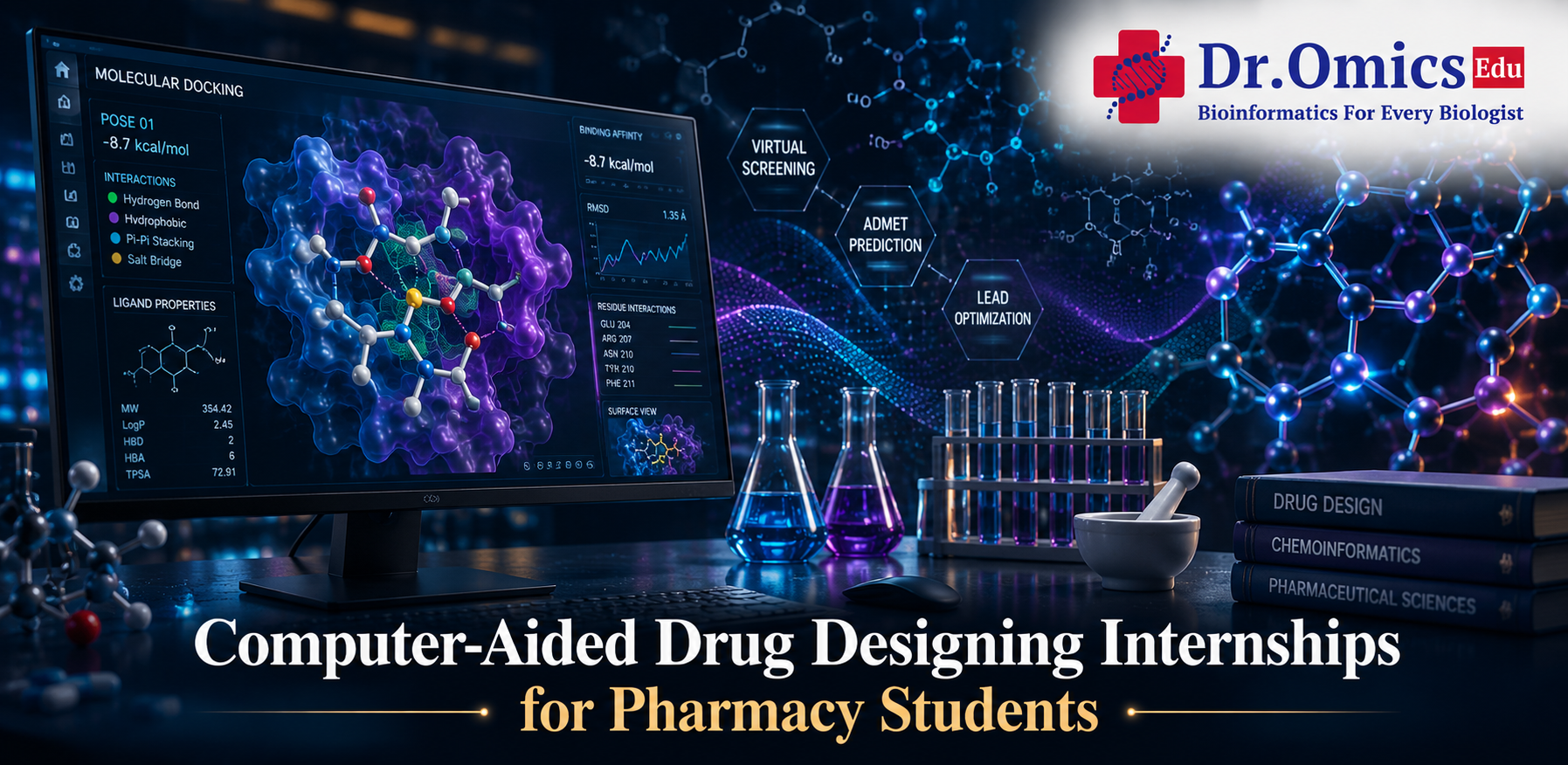
Computer-Aided Drug Designing Internships for Pharmacy Students
May 15, 2026
In 2026, the pharmaceutical landscape has shifted from traditional "hit-and-trial" methods to a digital-first approach. For B.Pharm and M.Pharm students, a CADD internship is no longer just an elective; it is a critical career accelerator. By integrating computational tools with pharmacological knowledge, pharmacy students are transforming into "In-Silico Research Analysts," significantly shortening the drug discovery timeline.
1. The Core of CADD Internships for B.Pharm
A CADD internship for B.Pharm students typically bridges the gap between medicinal chemistry and advanced software engineering. Unlike standard production or QA internships, CADD focuses on the very beginning of the drug life cycle—the design phase.
- Molecular Docking: Interns learn to predict how a drug molecule (ligand) interacts with a target protein (receptor). Mastering tools like AutoDock Vina or Schrödinger is essential.
- QSAR Modeling: Quantitative Structure-Activity Relationship (QSAR) allows students to predict the biological activity of new chemicals based on their molecular structure.
- Virtual Screening: Learning to filter millions of compounds in a digital library to find the most promising candidates, saving millions in laboratory costs.
2. Drug Discovery Training for Pharma
Comprehensive drug discovery training for pharma students in 2026 goes beyond software. It provides a holistic view of how a molecule moves from a computer screen to a clinical trial.
- ADMET Profiling: High-end internships train students to predict Absorption, Distribution, Metabolism, Excretion, and Toxicity (ADMET) using computational models. This is vital for ensuring a drug is not only effective but also safe for human consumption.
- Target Identification: Understanding how to use genomic and proteomic data to identify new disease targets, a skill highly valued by top biotech firms like Biogen and Takeda.
3. Molecular Dynamics Simulation Course
While docking provides a static "snapshot," a molecular dynamics (MD) simulation course teaches students how molecules move and change over time in a biological environment.
- GROMACS & NAMD: These are the industry-standard tools used in 2026. Students learn to simulate a protein-ligand complex in a "water box" to see if the drug stays bound under physiological conditions.
- Stability Analysis: Interns calculate parameters like RMSD (Root Mean Square Deviation) and RMSF to assess the stability of their designed drug molecules.
4. Career Impact and Top Recruiters
In 2026, top-tier pharmacy colleges and specialized training centers like BDG LifeSciences and DrOmics Labs have established robust placement records for CADD-trained graduates.
- Who is Hiring? Multinational giants like Pfizer, Novartis, and AstraZeneca, along with specialized CROs (Contract Research Organizations) such as Syngene and Eurofins, are actively seeking pharmacy graduates with CADD expertise.
- Salary Trends: While a traditional B.Pharm fresher may start at ₹2.5–3.5 LPA, students with certified CADD and MD simulation skills are securing roles as Junior Computational Chemists with starting packages ranging from ₹4.5 to ₹7 LPA.
Conclusion: Designing the Future
For a pharmacy student in 2026, mastering Computer-Aided Drug Designing is the key to moving from the retail counter to the research lab. By combining your knowledge of pharmacology with a high-impact CADD internship, you aren't just looking for a job—you are positioning yourself at the forefront of the next pharmaceutical revolution.
