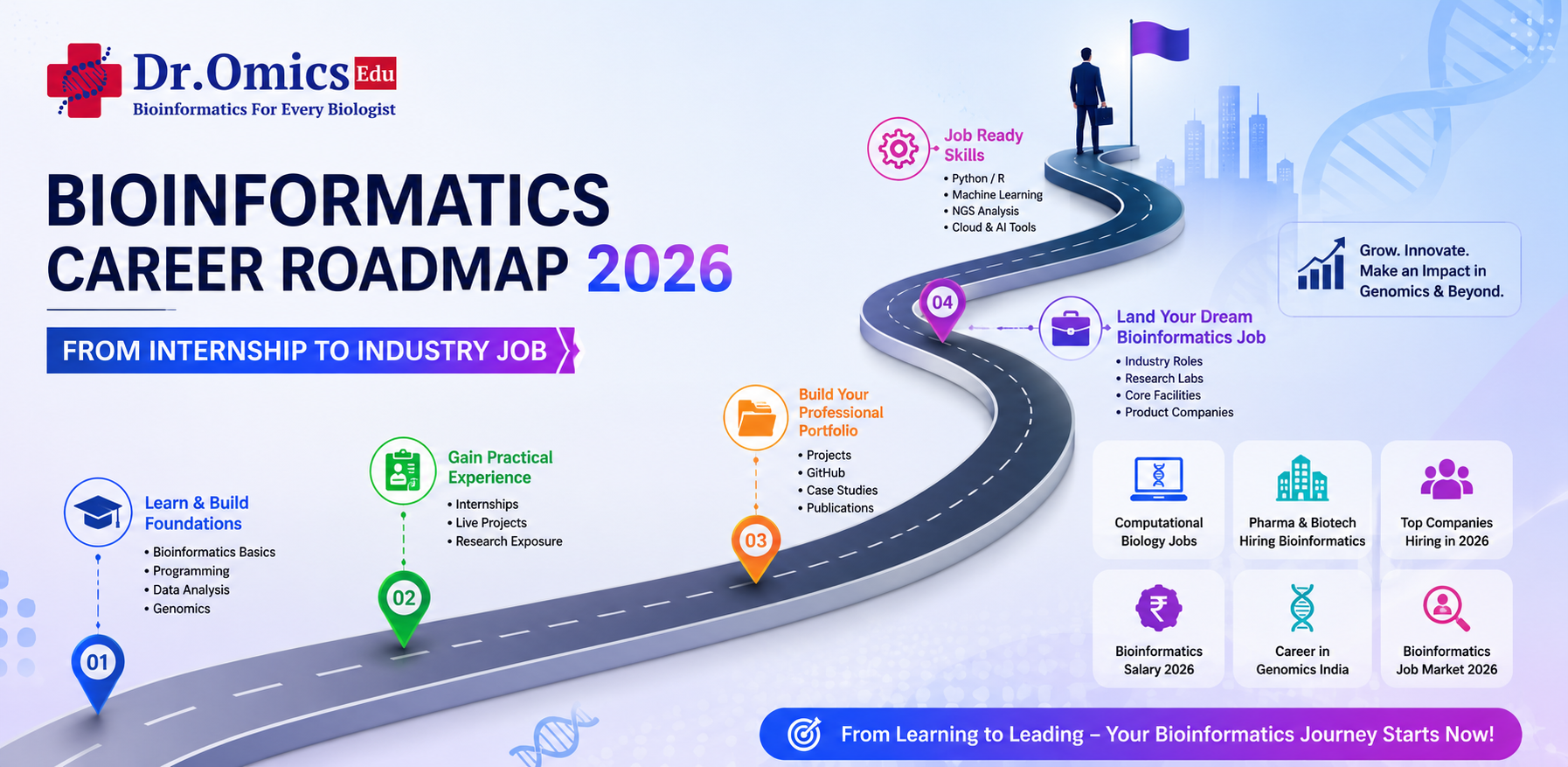
Bioinformatics Career Roadmap 2026: From Internship to Industry Job
June 21, 2026
The demand for bioinformatics professionals is growing rapidly as genomics, AI, precision medicine, and drug discovery continue to expand. If you're a life science student wondering how to turn a bioinformatics internship into a full-time role, this roadmap will help you navigate the journey.
Why Choose a Career in Bioinformatics?
The bioinformatics job market in 2026 is stronger than ever. Organizations across healthcare, biotechnology, pharmaceuticals, agriculture, and genomics research are actively seeking professionals who can analyze biological data and generate meaningful insights.
Popular computational biology jobs include:
- Bioinformatics Analyst
- Genomics Data Scientist
- Computational Biologist
- NGS Data Analyst
- Clinical Bioinformatician
- Multi-omics Scientist
- AI in Genomics Specialist
Step 1: Build a Strong Foundation
Before applying for internships or jobs, focus on developing core skills:
Essential Technical Skills
- Linux command line
- Python or R programming
- Statistics and data analysis
- NGS data analysis
- RNA-seq and variant analysis
- Biological databases and genomics tools
- Data visualization
These are among the most important skills for a bioinformatics job in 2026.
Step 2: Gain Hands-On Experience Through Internships
An internship is often the first step in the bioinformatics internship to job journey. During your internship:
- Work on real-world datasets
- Learn workflow development
- Practice result interpretation
- Improve scientific communication skills
- Contribute to research projects
Employers value practical experience just as much as academic qualifications.
Step 3: Create a Strong Portfolio
A well-designed portfolio for a bioinformatics career can significantly improve your job prospects.
Include:
- RNA-seq analysis projects
- Differential gene expression studies
- Variant calling workflows
- Python or R scripts
- GitHub repositories
- Research posters or publications
A portfolio demonstrates your ability to solve real biological problems using computational tools.
Step 4: Learn Industry-Relevant Technologies
Modern employers expect familiarity with technologies beyond traditional bioinformatics.
Focus on:
- Machine Learning for genomics
- Cloud computing
- Workflow management tools
- Multi-omics analysis
- AI-driven biological data analysis
These skills are increasingly important in computational biology industry jobs.
Step 5: Transition from Internship to Full-Time Job
Many students ask, "How do I get a bioinformatics job after internship?"
The answer is simple:
- Build strong technical skills
- Complete practical projects
- Network with professionals
- Maintain an updated LinkedIn and GitHub profile
- Apply consistently to entry-level positions
Internships often serve as a direct pathway to full-time employment when combined with a strong project portfolio.
Industries Hiring Bioinformaticians in 2026
The biggest opportunities are coming from:
- Pharmaceutical companies
- Biotechnology startups
- Genomics companies
- Healthcare and diagnostics organizations
- CROs (Contract Research Organizations)
- Research institutes and universities
Pharma and biotech hiring for bioinformatics roles continues to increase due to the growing use of genomics and precision medicine.
Bioinformatics Salary Outlook 2026
Salaries vary based on skills, experience, and location. Professionals with expertise in NGS, AI, machine learning, and cloud computing often command higher salaries than those with only traditional bioinformatics skills.
The combination of biology, programming, and data science remains one of the most valuable skill sets in the life sciences industry.
Future of Bioinformatics Careers
The future of careers in genomics in India and globally looks extremely promising. As sequencing costs decrease and biological data grows exponentially, organizations need skilled professionals who can transform data into discoveries.
Final Takeaway
The ideal bioinformatics career path in 2026 is straightforward:
Learn → Practice → Intern → Build a Portfolio → Network → Get Hired
Whether you're a life science student, biotechnology graduate, or aspiring computational biologist, the key to success is combining biological knowledge with computational expertise. Those who develop strong analytical skills and gain hands-on project experience will be well-positioned for the exciting opportunities emerging in genomics and bioinformatics.
