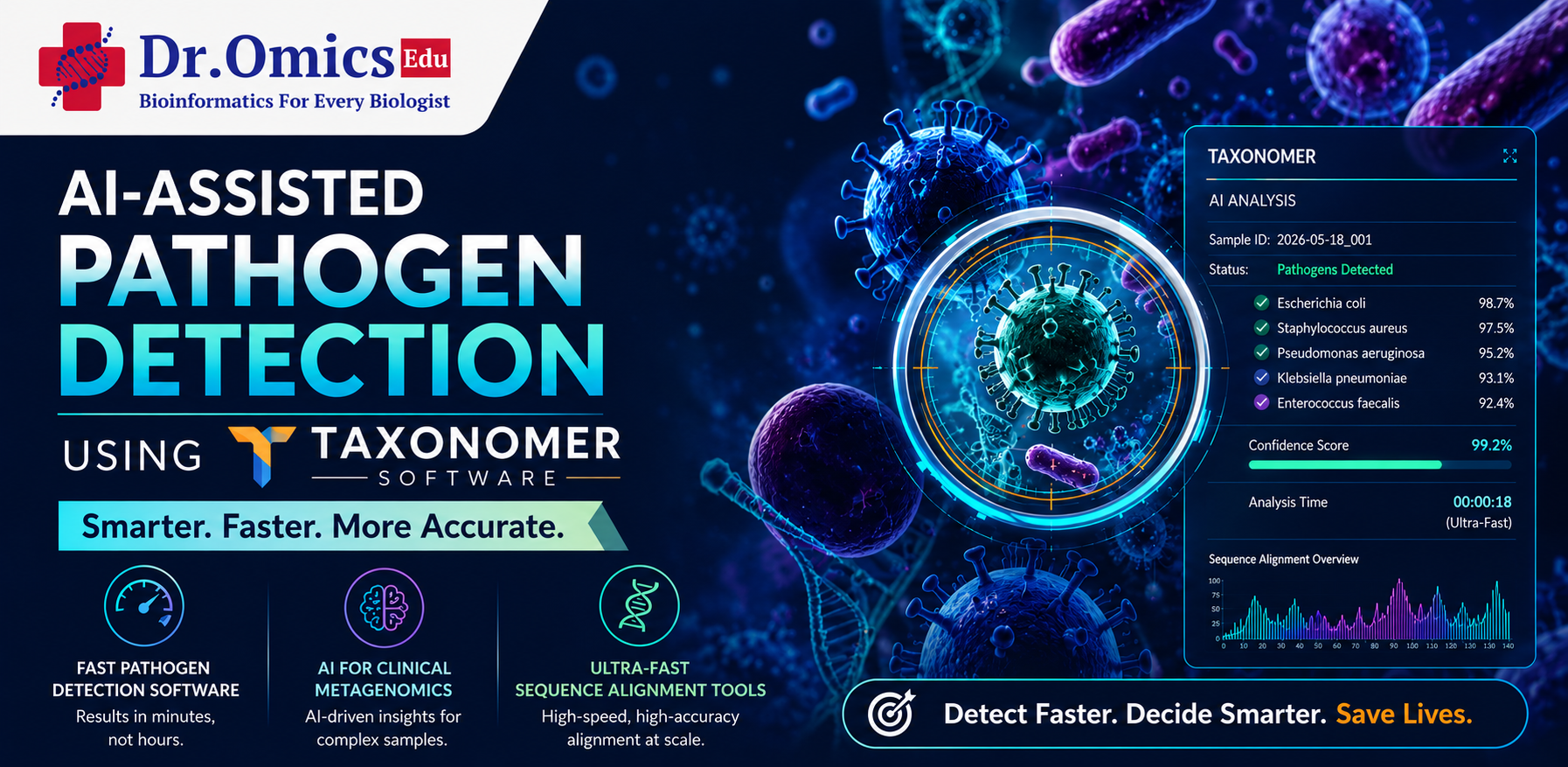
AI-Assisted Pathogen Detection Using Taxonomer Software
May 16, 2026
Rapid and accurate pathogen detection has become a critical part of modern healthcare and infectious disease research. Traditional diagnostic methods often require culturing microorganisms or running targeted tests, which can take several hours or even days. With the rise of genomic technologies and artificial intelligence, researchers can now detect pathogens much faster using advanced computational tools. One such powerful tool is Taxonomer, which is designed for rapid identification of microbial organisms from sequencing data.
Taxonomer is considered one of the most efficient fast pathogen detection software tools used in clinical genomics and infectious disease studies. It allows researchers and clinicians to analyze sequencing data quickly and identify viruses, bacteria, fungi, or other pathogens present in a biological sample. This capability is especially valuable in situations where rapid diagnosis is required, such as outbreaks, hospital infections, or emerging diseases.
The Role of AI in Clinical Metagenomics
Modern diagnostic approaches increasingly rely on AI for clinical metagenomics, where sequencing data from a sample is analyzed to identify all microorganisms present. Instead of looking for a single pathogen, metagenomic analysis examines the entire microbial community within a sample.
AI-powered computational methods help process the enormous amount of data generated during sequencing. By using machine learning and optimized algorithms, these tools can quickly classify sequences and match them with known microbial genomes. This significantly reduces the time needed to identify pathogens compared to traditional methods.
Taxonomer integrates advanced algorithms and intelligent classification techniques to perform rapid taxonomic identification. This makes it a valuable tool for researchers working in genomics, microbiology, and clinical diagnostics.
How Taxonomer Works
Taxonomer analyzes sequencing reads and compares them with large reference databases containing genomic information from different microorganisms. Using ultra-fast sequence alignment tools, it rapidly classifies each sequence and assigns it to the correct taxonomic group.
The software typically performs several important steps during analysis:
- Processing sequencing reads from genomic datasets
- Classifying sequences into microbial categories
- Detecting pathogens present in the sample
- Providing taxonomic summaries and visualization
Because of its optimized computational algorithms, Taxonomer can analyze large sequencing datasets much faster than many conventional bioinformatics pipelines.
Advantages of Using Taxonomer
One of the major advantages of Taxonomer is its speed and efficiency. As a fast pathogen detection software, it can process sequencing data quickly and provide results within a short time. This makes it extremely useful for clinical diagnostics and outbreak investigations.
Another benefit is its ability to work with metagenomic data. Using AI for clinical metagenomics, researchers can identify multiple pathogens simultaneously, even in complex biological samples containing diverse microbial populations.
Taxonomer also relies on ultra-fast sequence alignment tools, which allow the software to scan large genomic databases and classify sequences accurately. This helps researchers detect pathogens that might otherwise be difficult to identify using conventional diagnostic methods.
Applications in Clinical and Research Settings
AI-assisted pathogen detection using Taxonomer has several important applications in modern life sciences. In clinical settings, it can help doctors identify infectious agents more quickly and guide treatment decisions. In research laboratories, scientists use it to study microbial communities and understand how pathogens interact with hosts.
Taxonomer is also useful for outbreak monitoring, public health surveillance, and studying emerging infectious diseases. Its ability to analyze large sequencing datasets makes it an important tool in the growing field of genomic medicine.
Conclusion
The integration of artificial intelligence and genomic sequencing is transforming pathogen detection and disease diagnostics. Tools like Taxonomer demonstrate how fast pathogen detection software can accelerate the identification of infectious agents and improve response times in healthcare and research.
By combining AI for clinical metagenomics with ultra-fast sequence alignment tools, Taxonomer enables researchers and clinicians to analyze complex sequencing data efficiently and accurately. As genomic technologies continue to evolve, AI-assisted pathogen detection will play an increasingly important role in modern medicine and infectious disease research.
